
Table of Contents
- Mastering Go-to-Market (GTM) Strategy with Agentic AI
- Core Components of a Go-to-Market Strategy
- Building a GTM Strategy from Scratch
- Creating Your Own GTM Strategy: A Step-by-Step Approach
- Advanced GTM Tactics with Agentic AI
- Frequently Asked Questions About GTM Strategy
- Elevate Your GTM Execution with Agentic AI
Mastering Go-to-Market (GTM) Strategy with Agentic AI
A well-defined go-to-market plan is the compass for any successful product launch or market entry, aligning marketing, sales, and product teams around a unified path to the customer. We see a go-to-market strategy as more than a checklist; it is a dynamic system for capturing demand. Agentic AI fundamentally upgrades this system, transforming static planning into a continuous, intelligent loop.
Our approach centers on providing real-time AI powered market intelligence that instantly analyzes shifting trends and competitor gaps, removing the guesswork from your GTM strategy. This allows for precise, localized execution through our geo-pinned #name portals, turning broad market segments into manageable, targeted territories. Your portal becomes the gateway for AI agents, like GIGI, to automate GTM tasks and engage buyers with personalized, human-like interactions at scale.
This unified system establishes Agentic SEO as a primary GTM channel, ensuring your brand is discoverable within the AI-driven search environments where modern buyers look. By shifting from fragmented legacy analytics to our integrated agentic model, you evolve your go-to-market motion from a periodic project into an always-on engine for growth. We unify CRM and web analytics to enable continuous optimization, privacy-aware personalization, and faster responses to shifting local market conditions at scale globally.
Core Components of a Go-to-Market Strategy
Building on the foundational understanding of what a go to market plan entails, we now examine the essential building blocks that make any launch successful. A well-constructed go-to-market strategy serves one primary purpose: to introduce a product or service to the right customers through the most effective channels. Whether approaching this process with traditional methods or leveraging modern AI capabilities, the core components remain consistent, though the execution has been transformed by technology.
At its heart, every GTM strategy rests on five interconnected pillars. Market intelligence and research forms the foundation, providing the data needed to understand competitive landscapes and customer needs. Target audience definition narrows the focus to the specific segments most likely to convert. A compelling value proposition articulates why those customers should choose your solution over alternatives. Go-to-market channels determine where and how you will reach your audience. Finally, pricing and sales strategy establishes the commercial framework that makes the entire effort sustainable.
Traditionally, assembling these components relied on manual processes. Market research meant commissioning surveys and conducting focus groups, a process that could stretch across weeks or even months. The Interactive Advertising Bureau has long served as the authoritative benchmark for advertising measurement and marketing standards, providing the frameworks that guided these traditional approaches. Content creation moved at the speed of human teams, lead generation depended heavily on outbound calls and industry events, and pricing decisions emerged from spreadsheet-based competitive analysis.
The landscape has shifted dramatically. Today, an AI market intelligence platform like the one we offer at hashtag.org enables real-time competitive analysis, sentiment tracking, and automated data aggregation, compressing research timelines from months to days. This transformation touches every component of the GTM strategy.
The following table illustrates how AI has redefined each aspect of the go-to-market process:
| Aspect | Traditional GTM | AI-Enabled GTM |
|---|---|---|
| Speed to Market | Weeks to Months | Days |
| Customer Research | Surveys, focus groups | Real-time data, sentiment analysis |
| Content Creation | Manual, slow | Automated, personalized |
| Lead Generation | Outbound, events | AI-powered targeting |
| Pricing Strategy | Manual analysis | Dynamic pricing models |
These contrasts reveal a fundamental shift in how businesses approach market entry. Where traditional methods produced static snapshots of market conditions, AI-driven approaches deliver continuous intelligence that adapts as conditions change. Content that once required weeks of production can now be generated and personalized at scale. Lead generation moves from broad outreach to precision targeting informed by behavioral signals and predictive analytics.
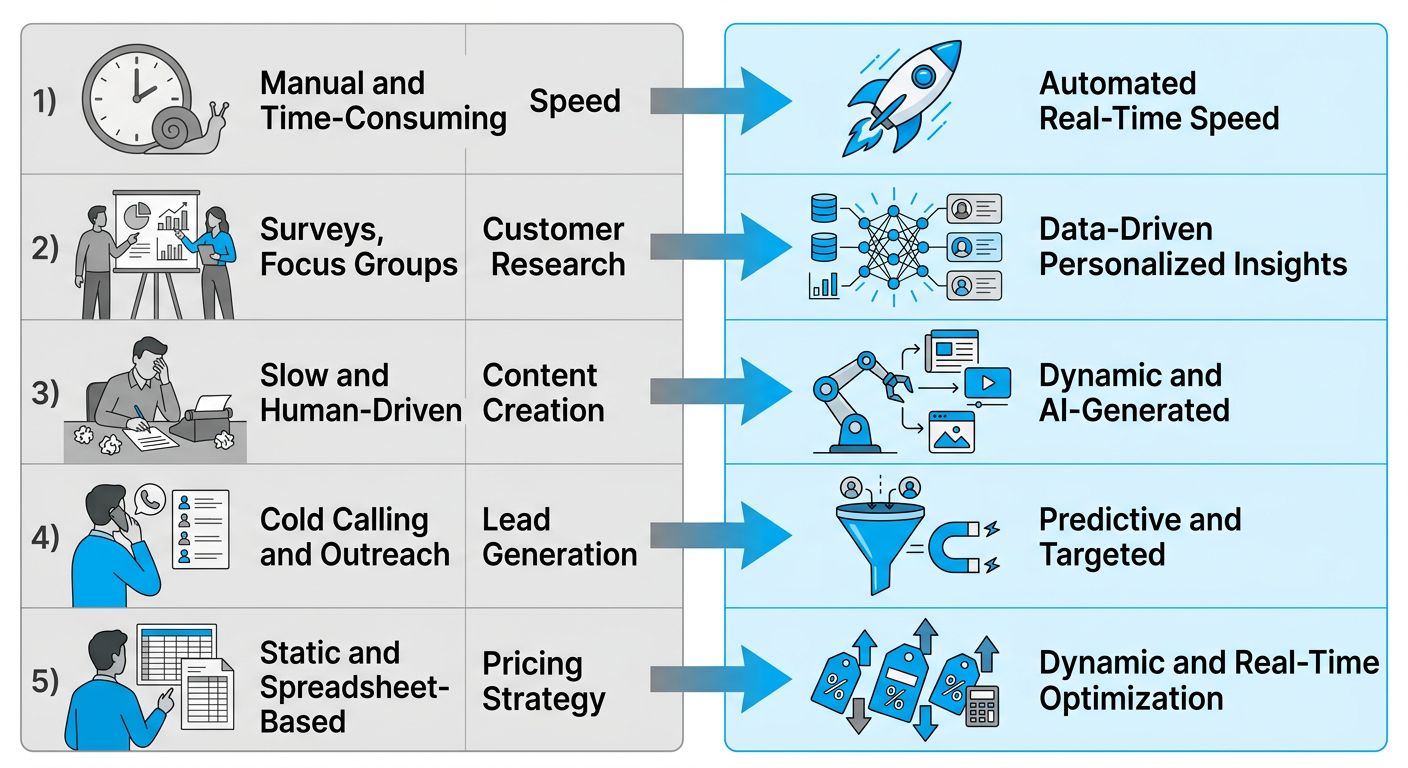
Transformation from manual to AI-powered GTM strategies visualized in a comparative infographic.
This evolution from manual to AI-enabled methods does not discard the foundational components of a GTM strategy, it accelerates and refines them. The transformation we have outlined here sets the stage for the next section, where we will explore how to build a practical AI-powered go-to-market plan that puts these capabilities to work for your business.
Building a GTM Strategy from Scratch
A go-to-market strategy is the tactical action plan that defines how we reach target customers and achieve a competitive advantage when launching a new product or service. At its core, it aligns our product, pricing, and channels with a clearly defined audience to ensure a successful market entry. Without a structured GTM plan, even the most innovative solutions can struggle to gain traction, as resources become scattered and messaging fails to connect with the right buyers.
We build a GTM strategy to de-risk launches and shorten the path to revenue. The process starts with deep research, crystallizes around a unique value proposition, and finishes with a deliberate selection of distribution channels. Each component must work in harmony, guided by data rather than assumptions, to create a repeatable system for growth.
Market Analysis and Customer Persona Development
Thorough market analysis is the foundation of any effective GTM strategy. We begin by sizing the opportunity, looking at the Total Addressable Market (TAM), Serviceable Addressable Market (SAM), and Serviceable Obtainable Market (SOM) to understand the realistic revenue potential. Next, we map the competitive landscape to identify gaps where our solution can uniquely win. Modern teams accelerate this phase by using AI market intelligence tools that automate data gathering and reveal real-time market shifts.
From this research, we develop an Ideal Customer Profile (ICP). An ICP is a detailed description of the company or individual that benefits most from our product, covering firmographics, pain points, and buying behaviors. The Association of National Advertisers (ANA) provides well-established frameworks for this segmentation work, emphasizing a data-driven approach to understanding audience motivations. With a clear ICP, we avoid wasting resources on prospects who are unlikely to convert, focusing instead on high-probability opportunities.
Crafting Your Value Proposition and Messaging
A unique value proposition (UVP) is the clear statement that describes why our solution is different and worth buying. It is not a tagline but a promise of a specific outcome our customers can expect. To develop it, we map our product’s features directly to the pain points identified in our ICP, quantifying the value wherever possible. The most compelling UVPs replace vague claims like “best-in-class” with concrete results a customer can measure.
Once the UVP is finalized, we build a messaging house that translates that core promise into a narrative for different audiences. This includes a positioning statement, key benefit pillars, and supporting proof points. Our goal is to ensure that every piece of communication, from a homepage headline to a sales email, reinforces the same story in a consistent voice. This strategic alignment builds trust and makes our market entry feel coherent and intentional.
Selecting Distribution Channels and Tactics
Choosing the right mix of distribution channels determines whether our message reaches the ICP effectively. We evaluate options such as content marketing, paid advertising, direct sales teams, and partnership ecosystems against criteria like reach, cost, buyer preference, and our own operational capacity. There is no universally correct answer, the best channel mix reflects where our specific customers spend their time and how they prefer to learn about new solutions.
We also consider the broader GTM model that frames these tactical choices. The selection of channels flows naturally from a strategic decision about how we primarily drive growth. The following table compares four dominant models to clarify which approach suits different business types and customer expectations.
Comparison of GTM Strategy Models
The right GTM model aligns your growth engine with how your target customers actually buy. Each model below defines a different relationship between the product and the revenue engine.
| Model | Best For | Key Features |
|---|---|---|
| Product-Led Growth | SaaS with freemium | Self-serve, viral loops |
| Sales-Led Growth | Enterprise, high-ticket | Direct sales, demos |
| Marketing-Led Growth | B2C, ecommerce | Content, paid ads |
| Community-Led Growth | Developer tools | User forums, advocacy |
Product-led growth relies on the product itself to acquire and retain users, making it highly efficient for software with a quick time-to-value. Sales-led growth, in contrast, puts a consultative sales force at the center, which is essential for complex solutions requiring relationship building and custom configurations. Marketing-led models generate demand at scale through broad awareness campaigns, while community-led strategies build deep loyalty and advocacy in specialized niches. Our job in building a GTM strategy is to select the model that best fits our product complexity, deal size, and customer expectations, then select the tactics that make that model operational.
A well-defined GTM strategy brings clarity and focus to a product launch. By systematically analyzing the market, defining a sharp value proposition, and deliberately selecting the right channels and growth model, we create a blueprint that coordinates our team’s efforts and accelerates our path to market success.
Creating Your Own GTM Strategy: A Step-by-Step Approach
Now that you understand why a go to market approach is essential for launching successfully, we want to share a practical, step-by-step framework you can use to build your own. A well-structured go to market strategy removes guesswork and helps you align your team, your message, and your tactics around a clear market entry plan. Whether you are introducing a new product, expanding into a new geography, or repositioning an existing brand, a methodical GTM strategy gives you the roadmap to do it with confidence. When you layer in AI tools like the ones we offer at Hashtag.org, each step becomes faster, smarter, and more data-driven.
Define Your Target Market and Buyer Persona
Your launch begins with a precise definition of who you are selling to. We recommend building detailed buyer personas that capture not just demographics but behaviors, goals, and pain points. Traditional market research often relies on manual browsing and static reports, which can be slow and shallow. With Hashtag.org’s AI market intelligence, you can surface real-time signals about market shifts, competitor moves, and consumer sentiment almost instantly. Our geo-pinned portals give you location-specific insights, so you understand how buyer needs vary by region without sifting through spreadsheets.
Instead of basic demographic splits, our platform enables behavioral clustering that segments audiences based on how they actually interact with content and channels. This deeper view of your audience helps you create messaging that resonates from day one. By feeding these insights into your buyer personas, you move from assumptions to evidence-based profiles that guide every downstream decision in your go to market plan.
Develop Your Product Positioning and Pricing
Once you know your audience, you must clarify how your product fits into their world and what they are willing to pay. Effective positioning articulates the unique value you deliver relative to alternatives, while pricing must reflect that value without leaving money on the table. In our experience, this step benefits enormously from competitive intelligence that is continuously updated, not locked in a static spreadsheet.
Hashtag.org’s real-time monitoring tracks how competitors price, position, and promote their offerings, so you can identify gaps and opportunities the moment they appear. Our AI market intelligence goes further by analyzing customer willingness to pay signals and industry benchmarks, helping you set a transparent pricing model grounded in data rather than guesswork. With this intelligence, you can craft positioning statements that differentiate your product clearly and adjust pricing tiers as market conditions evolve, all while maintaining a clear, compliant GTM framework.
Outline Your Sales and Marketing Plans
With your target market and positioning defined, the final step is building a coordinated set of sales and marketing activities that drive awareness, engagement, and conversions. We’ve seen many teams struggle to scale content creation, personalize outreach, and manage campaigns across channels. That’s where agentic AI and automation transform execution.
Our AI content creation tools enable you to generate campaign assets—blogs, social posts, landing pages—at scale without sacrificing brand voice. Through the Tavus partnership, we bring Agentic AI-powered personalized video into your GTM campaigns: imagine video agents that greet prospects by name, answer questions, and even capture leads or book meetings right on your website. This level of personalization was once reserved for enterprise budgets but is now accessible through our agentic harness.
Behind the scenes, AI workflow automation orchestrates lead scoring, distribution, and follow-up. Instead of static, rules-based lead routing, our platform uses predictive scoring that learns from outcomes and improves over time. These agentic workflows reduce repetitive manual work and keep your team focused on high-value conversations. Your #portal acts as the command center, integrating CRM connectivity, cross-channel coordination, and real-time analytics so every marketing dollar and sales minute is spent where it delivers the most impact.
| Task | Without AI | With AI Tools (hashtag.org) |
|---|---|---|
| Market Research | Manual browsing, reports | AI market intelligence |
| Audience Segmentation | Basic demographic splits | Behavioral clustering |
| Competitive Analysis | Spreadsheets | Real-time monitoring |
| Content Generation | Manual writing | AI content creation |
| Lead Scoring | Rules-based | Predictive scoring |
The table above highlights how AI transforms core planning tasks across the board. Market research moves from days of manual searching to instant intelligence. Segmentation shifts from shallow demographics to nuanced behavioral clusters. Competitive analysis becomes continuous and proactive. Content scales without linear cost growth, and lead scoring gets smarter with every interaction. While human oversight remains essential for strategic decisions, these AI capabilities allow you to iterate faster and launch with greater precision.
Once your plan is outlined, you are ready to execute and monitor results using AI tools. The next phase is about activating your agents, measuring performance, and refining your approach based on live data—something we will explore in the sections ahead. Please note that AI-generated content may be inaccurate and should be reviewed before use. We do not guarantee specific outcomes; success depends on your market conditions, execution, and ongoing optimization.
Advanced GTM Tactics with Agentic AI
Building on fundamental go-to-market frameworks, we now turn to the tactical layer where agentic AI transforms execution. These autonomous agents handle multi-step GTM tasks without human intervention, moving beyond basic automation to intelligent, adaptive action.
Manual vs Agentic AI Execution in GTM
The following table illustrates how agentic AI outperforms manual execution across key GTM capabilities.
| Task | Without AI | With AI Tools (hashtag.org) |
|---|---|---|
| Market Research | Manual browsing, reports | AI market intelligence |
| Audience Segmentation | Basic demographic splits | Behavioral clustering |
| Competitive Analysis | Spreadsheets | Real-time monitoring |
| Content Generation | Manual writing | AI content creation |
| Lead Scoring | Rules-based | Predictive scoring |
This comparison reveals a fundamental shift in how a go to market strategy operates. Rather than relying on periodic reviews and reactive adjustments, teams can now deploy AI agents that continuously learn and adapt. In today's fast-paced digital landscape, any effective gtm strategy must incorporate this level of responsiveness to remain competitive. We design agents to ingest signals across CRM, web analytics, and social feeds for contextual decision-making. That continuous input enables faster hypothesis testing and more relevant outreach without replacing human oversight or strategy.
Our platform's AI-powered market intelligence ingests real-time trend data, competitor signals, and consumer behavior patterns to feed dynamic strategies. This approach aligns with digital advertising industry standards, replacing static weekly reports with actionable, live dashboards. The autonomous nature of agentic AI means that experiments run continuously, optimizing performance without constant human oversight.
These advanced tactics are immediately accessible through our agentic AI suite, allowing you to activate autonomous agents that personalize outreach and automate follow-ups based on actual prospect behavior. Your #portal becomes the command center where your go to market execution scales intelligently.
Frequently Asked Questions About GTM Strategy
With the core components in mind, let’s address common questions.
What is a go to market strategy?
We define a go to market strategy as the action plan that brings a product or service to the right audience through the most effective channels. It coordinates positioning, messaging, and launch timing so the market understands your value immediately.
What are the key components of a GTM strategy?
A sound GTM strategy rests on five pillars: a well-defined target audience, a clear value proposition, distribution channels, pricing, and competitive positioning. Each component aligns the launch team around who you serve, what you promise, and how you deliver it profitably.
How is a GTM strategy different from a marketing strategy?
A marketing strategy focuses on ongoing demand generation and brand building, while a go to market strategy is the focused launch blueprint. The GTM plan covers product readiness, sales training, and initial traction, which marketing alone doesn’t address.
Why is a GTM strategy important for startups?
Startups face limited resources and reputational risk, so a disciplined GTM strategy reduces missteps and speeds adoption. It forces teams to validate audience-product fit before scaling, so early revenue and feedback arrive faster.
How does a GTM strategy apply to AI agents and digital products?
For AI agents, a GTM strategy must include persona-driven engagement and discovery layers that conventional marketing misses. We build geo-pinned #portals and persona-cloned AI agents so your product is visible where your audience searches and the agent converts in your voice. A solid GTM strategy is foundational — explore how our agentic tools can support your next launch plan.
Elevate Your GTM Execution with Agentic AI
Today’s complex go to market landscape demands speed and precision. Agentic AI automates lead engagement and content personalization, transforming how we execute strategies. We anchor your brand with a geo-pinned portal—your storefront on the map.
Geo-pinned portal discovery connects you with high-intent audiences. Persona-cloned agents consistently answer inquiries in your brand's voice, while built-in payments close deals instantly for immediate revenue. Tap into marketer association and resources best practices to refine your go-to-market approach and accelerate GTM execution. Stay tuned as we dive deeper into Agentic SEO.
Resources
- Reduce Reporting Time with AI-Powered Market Intelligence
- Integrate AI Market Intelligence with Existing CRM Systems
- White-Label AI Market Intelligence Tools for Agencies
- Predict Market Trends with AI-Driven Intelligence
- Ensure Data Compliance with AI Market Intelligence
- Reduce Lead Costs with AI Workflow Automation Tools
- Automate Lead Qualification with Video AI Agents
- Discover Digital Advertising Standards from IAB
- Enhance Marketing Knowledge with ANA Resources and Training