Table of Contents
Understanding the People Also Ask Search Feature
The people also ask (PAA) feature is a dynamic Google Search element that displays a box of related questions directly below a user's query. We understand this feature as a powerful way to align content with informational search intent, offering users a deeper exploration path without additional searches.
When a user clicks a PAA question, it expands to reveal a concise answer sourced from a webpage, often accompanied by a link. This action then triggers additional related questions, creating an expanding thread of curiosity-driven results. For instance, when a user searches for what is a hashtag, the PAA box might reveal questions about hashtag usage and strategy. At hashtag.org, we see this as an opportunity for people also ask optimization through clear, authoritative content.
The significance of ranking in people also ask lies in its ability to enhance organic visibility for informational queries, providing a secondary entry point to your content beyond the traditional blue link. According to Google Search Central, creating people-first content that directly answers user questions is the most effective approach to appearing in these features. This section remains dynamic, changing based on location and search context.
Preparing Your Foundation for People Also Ask Success
Understanding what People Also Ask is marks only the first step. Appearing in People Also Ask results requires a foundation built on proven SEO fundamentals. We focus on site architecture, content depth, and technical signals that help Google identify your pages as authoritative sources for question-based queries.
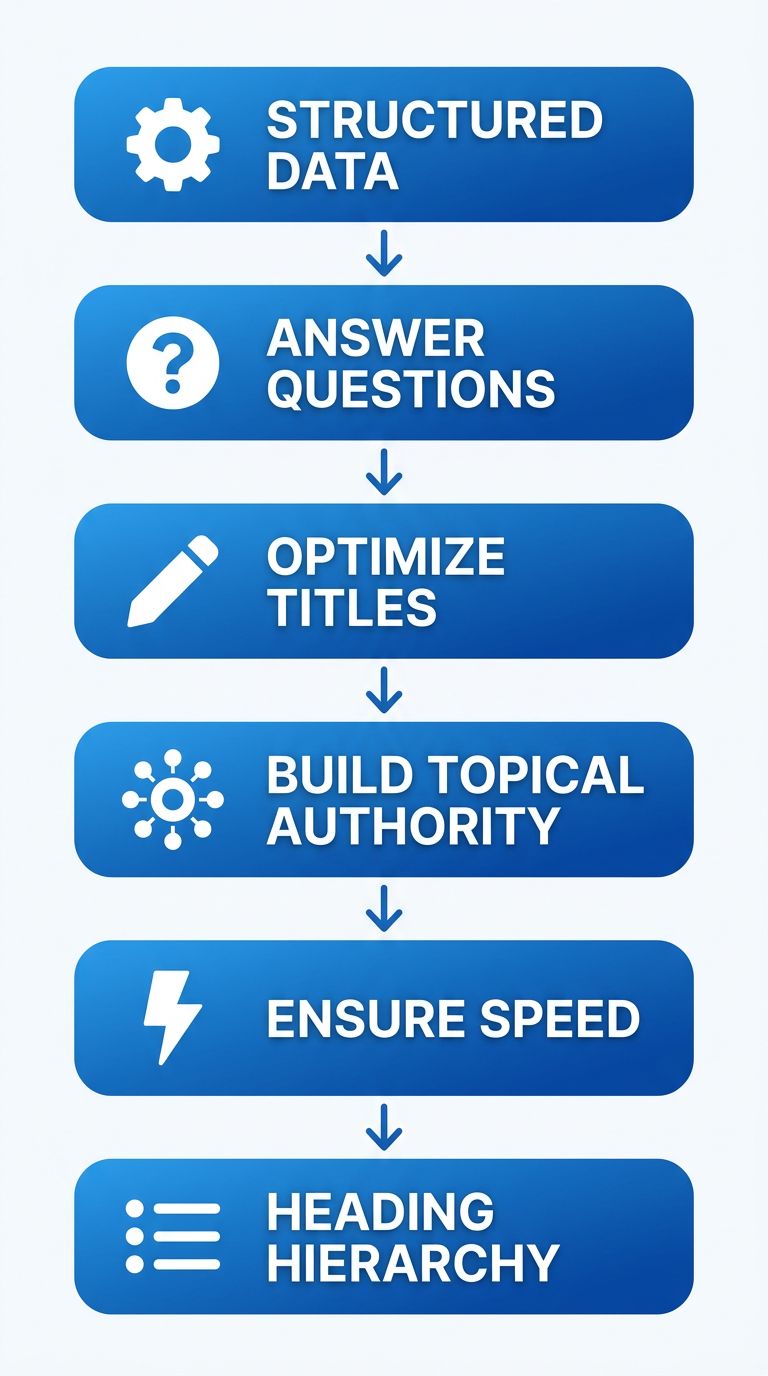
Effective people also ask optimization starts with these core elements:
- Implement FAQPage structured data to signal question-answer pairs to search engines, as Google's documentation recommends.
- Answer common user questions with concise, authoritative paragraphs placed directly below relevant headings.
- Optimize page titles and meta descriptions to align with question-based queries that trigger PAA features.
- Build topical authority by clustering related content and linking internally. Authoritative historical content, such as the history of the hashtag, demonstrates depth that search engines reward.
- Ensure fast page speed and mobile responsiveness, both critical ranking factors that influence rich result eligibility.
- Use clear heading hierarchy with H1, H2, and H3 tags to help search engines understand content structure.
Six-step foundation process for People Also Ask SEO success.
Identifying Question Opportunities Your Audience Searches
Once you know who your audience is, the next step is identifying the specific questions they ask. One of the most accessible ways to start is by exploring the people also ask boxes that appear on Google search results pages. These question-driven queries represent real searches from real users, giving you a direct view into the topics your audience cares about. By studying these patterns and looking for clusters of related queries, we gain a reliable signal for what to cover next.
Beyond manual review, we can analyze search data by filtering for question words such as who, what, where, when, why, and how. When we pair that insight with hash-tag-based discovery methods—understanding the hash symbol origin helps us see how social conversations organize around topics—we uncover the questions people ask across platforms. Improving your ranking in people also ask often starts with this kind of systematic question research, and people also ask optimization becomes natural when your content directly addresses the queries you have already documented.
Structuring Answers for Featured Snippets
Structuring answers for featured snippets and people also ask boxes requires a direct approach that mirrors the user's query exactly. We prioritize people also ask optimization by placing concise answers immediately after a relevant heading. According to Google Search Central, answers that directly address queries and use clear formatting have the best opportunity for featured snippet placement. Paragraph snippets should stay between 40 and 60 words, remaining self-contained and factually accurate without introductory phrases like "the answer is." For listicle-type featured snippets, we use bulleted or numbered lists where each item expresses a complete thought. Success in ranking in people also ask depends on integrating the target keyword naturally while avoiding over-optimization. Our Agentic SEO approach ensures answers stand alone without additional context, increasing their chances of appearing in PAA boxes and featured snippet opportunities. For the most current guidelines, refer to Google Search documentation updates.
Leveraging FAQ Schema for Enhanced Visibility
To capture visibility in people also ask sections, we implement FAQ schema — a structured data markup using JSON-LD that defines a list of questions and answers on a page. This is one of the most effective ways to support people also ask optimization, as it signals to Google that the content addresses specific user queries directly. Google Search Central specifies that FAQPage schema must appear on publicly accessible pages with visible Q&A content, not behind paywalls or login gates.
When correctly deployed, FAQ schema can increase click-through rates and give your content additional real estate in search results. For a broader foundation, the Google SEO starter guide offers structured data best practices that complement your ranking in people also ask efforts. Incorrect implementation, such as marking up non-Q&A or promotional content, risks losing rich results, so we validate our markup using the Google Rich Results Test tool.
Writing Concise and Direct Answers
Crafting Q&A pairs that resonate with search behavior is the cornerstone of effective People Also Ask visibility. Beyond markup alone, how you structure each answer determines whether it earns placement. We approach people also ask optimization as a disciplined writing practice—not a technical trick. The goal is clarity, conciseness, and compliance with Google's documented guidelines for FAQ content.
- Write each answer as a complete standalone sentence, avoiding introductory phrases like "it depends" or "to answer this."
- Keep answers between 40 and 60 words. This length aligns with the snippet space Google typically reserves.
- Use factual neutral language. Avoid promotional claims, subjective opinions, or superlatives.
- Frame questions as full natural queries users would type into search. Truncated phrases reduce matching potential.
- Make every Q&A pair self-contained. Never reference other pairs within the same markup.
Using Lists and Tables for Scannable Content
When users search for quick answers, People Also Ask boxes reward content that presents information clearly. Lists and tables make your answers easier for both readers and search engines to parse, directly supporting your people also ask optimization efforts.
We recommend matching formats to query types. Use bulleted lists for feature sets or options, numbered steps for tutorials, and tables for side-by-side comparisons. For example:
- Bulleted lists suit "what are the benefits" queries.
- Numbered steps answer "how do I" intent.
- Tables serve "compare X vs Y" searches.
By structuring content this way, you improve the odds of ranking in people also ask snippets. Google Search Central confirms that implementing FAQPage structured data on question-based pages helps search engines identify and feature that content. These techniques complement the Agentic SEO strategies we employ to enhance your portal's discoverability.
Monitoring and Updating Your PAA Performance
Effective People Also Ask optimization is not a one-time effort but an ongoing cycle of analysis and refinement. We recommend a consistent monitoring routine to track your PAA presence and adapt your strategy accordingly.
Regular review of impression share and click-through rate for queries triggering PAA boxes reveals how your content performs. Performance drops often signal that content can be fine-tuned to better match question intent, sharpening your people also ask optimization with each update.
As Google’s authoritative guidance indicates, monitoring search performance over time is essential for identifying opportunities. We find that observing competitor PAA appearances also uncovers new angles for your own content. A monthly cadence tied to content refresh cycles keeps your ranking in people also ask resilient without over-investing. This disciplined approach ensures your Agentic SEO engine remains aligned with shifting user needs and evolving search behaviors.
Integrating Agentic SEO for Continuous Optimization
Where traditional SEO serves as a static, one-time tune-up, Agentic SEO represents an AI-driven, ongoing process that continuously monitors, analyzes, and adjusts your content to capture dynamic search behaviors. We focus on automatically adapting to triggers like People Also Ask (PAA) boxes, enabling your brand to stay visible as questions evolve.
Integrating with Google's FAQ structured data is central to this approach. As Google Search Central documents, FAQ schema provides a mechanism for surfacing content within people also ask features and voice search answers. Our AI agents can autonomously identify high-value PAA triggers, update your schema markup, and refresh on-page Q&A content to remain relevant. This continuous optimization builds on the fundamentals outlined in Google's SEO starter guide—ensuring that content quality and technical soundness remain the bedrock of any people also ask optimization strategy. By auditing performance, refining answers, and aligning with shifting user queries, we work toward sustainable ranking in people also ask without chasing short-lived tactics.
Overcoming Common People Also Ask Optimization Challenges
People Also Ask (PAA) boxes are dynamic search features that surface relevant questions directly within Google's search results, pulling answers from pages that use structured data or clear question-and-answer formatting. While the visibility benefits of appearing in these results are well understood, several challenges consistently prevent websites from achieving consistent PAA inclusion.
One of the most common pitfalls is missing or improperly implemented FAQ structured data. According to Google Search Central, the FAQPage schema requires content to follow a strict question-and-answer format, with each answer functioning as a self-contained response that directly addresses the query without requiring surrounding context for comprehension. When pages embed questions within lengthy paragraphs, fail to mark up the content entirely, or structure answers in a way that references earlier sections, eligibility for PAA inclusion drops significantly.
Competing with high-authority sources presents another layer of difficulty. Even when pages technically meet structured data requirements, Google may still favor already-ranked domains with established topical authority for PAA placement. This means that content teams must go beyond schema compliance and ensure their answers are genuinely comprehensive, concise, and unique. Success with people also ask optimization hinges on respecting these constraints rather than treating PAA as a low-effort shortcut.
Mastering People Also Ask with Agentic SEO
Building on our exploration of Agentic AI and its transformative role in modern discovery, we turn our focus to a specific high-value SERP feature: People Also Ask (PAA). This dynamic, question-based panel expands user engagement by offering related queries directly within Google’s results, and it represents a critical frontier for AI-driven visibility strategies.
We define Agentic SEO as the orchestration of autonomous AI agents to research query clusters, structure precise content, and optimize for search—all within a governed, real-time framework. When applied to people also ask opportunities, these agents dissect vast theme landscapes to generate succinct, authoritative answers. The cornerstone of this approach, as Google Search Central outlines in its SEO starter guide, remains a focus on high-quality, people-first content paired with well-implemented structured data.
Our key takeaways for targeting the PAA feature include:
- Prioritizing concise answers that directly address the implicit question in a query.
- Implementing FAQ and Q&A schema to provide search engines with explicit answer structure.
- Leveraging autonomous agents to continuously refine content using performance signals.
Your channel. Your name. Your rules. We are committed to creating transparent pathways to AI visibility, though we note that AI-generated content may be inaccurate or outdated; you should review it before relying on it.
Resources
- Learn the History and Best Practices of Hashtags
- Discover the History of the Hashtag Symbol
- Discover the Origin of the Hash Symbol
- Get Agentic SEO Services for Pest Control
- Learn How Pest Control SEO Drives Local Leads
- Get Agentic SEO Services for Plumbing Companies
- Get Water Damage Leads with Agentic SEO
- Explore Google Search Central Documentation Updates
- Learn SEO Basics with Google's Starter Guide