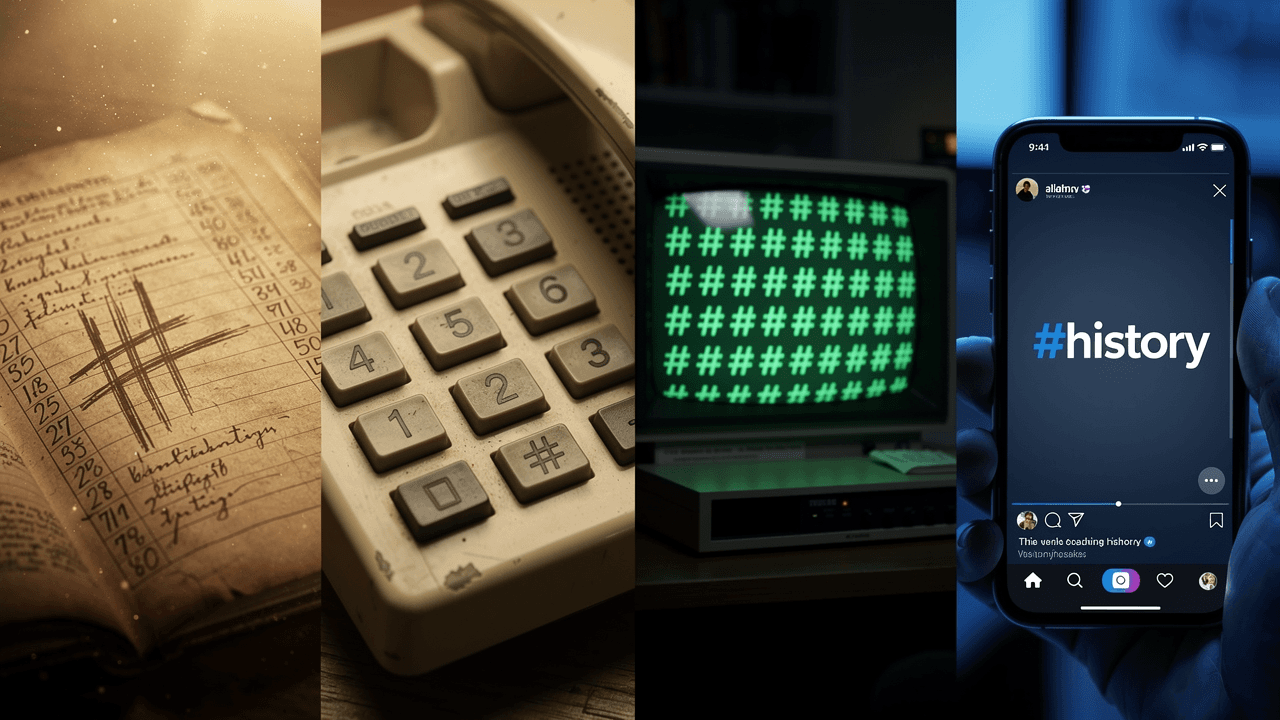
Most people meet the # symbol as the hashtag, the thing you put in front of a word on Instagram or X. But the symbol itself is ancient. It started as a shorthand for a Roman unit of weight, spent centuries as the “pound” and “number” sign, picked up a joke name at a telephone company, lived quietly inside computer code for decades, and only became the hashtag in 2007.
That is a longer and stranger story than the symbol usually gets credit for. This series digs the whole thing up, one chapter at a time. Here is the arc; each chapter that follows goes deep.
A Roman pound, written in a hurry
The symbol traces back to the Latin phrase “libra pondo,” meaning “a pound by weight.” Medieval scribes abbreviated the “libra” half as “lb” and drew a bar across the top to mark it as a contraction. Written quickly, over and over, in ledgers and account books, that crossed “lb” slowly collapsed into the four-stroke grid we now write as #.
That single origin explains a surprising amount. It is why, in the United States, # still means “pounds” of weight (as in 5#) and “number” (as in #1), and it is why a phone prompt tells you to “press pound.” The same Latin word, libra, also gave us the abbreviation “lb” for weight and the “£” sign for the British pound.
From the keypad to the keyboard
In the late 1960s, engineers at Bell Labs added # and * to the new touch-tone telephone keypad, and they coined a deliberately odd name for the # key: the octothorpe. Around the same time the symbol was settling into computing. It marked directives in the C programming language, comments in scripts, and, in 1988, channels on Internet Relay Chat. That last use, a # in front of a shared topic anyone could join, is the hashtag’s direct ancestor.
And then, the hashtag
On 23 August 2007, a technologist named Chris Messina suggested on Twitter that people use the # to group messages, “as in #barcamp.” Twitter was unimpressed at first. Then real events, starting with the 2007 San Diego wildfires, showed how useful a shared, searchable tag could be, and the idea took off. Twitter made hashtags clickable in 2009, every major platform followed, and the symbol jumped from a niche convention to a word people say out loud.
From there it organized movements, marketing campaigns, and everyday conversation. The chapters below tell each part properly: where the symbol came from, the full octothorpe story, all its strange names, its decades inside code, who really invented the hashtag, and how it changed the world.