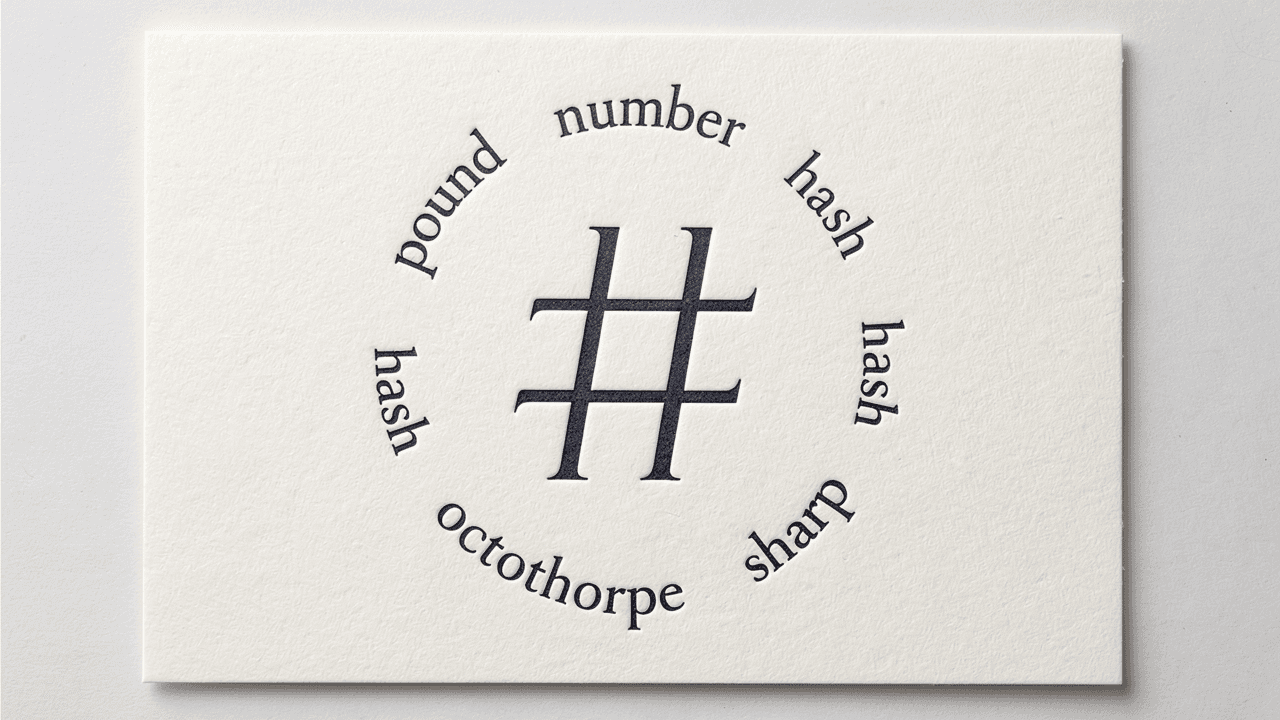
Few symbols answer to as many names as #. What you call it says a lot about where you grew up, what you do for a living, and which decade you learned it in.
Number sign and pound sign (mostly American)
In the United States, # before a figure means “number” (#1 is “number one”) and after a figure means “pounds” of weight (10# is “ten pounds”). Both meanings come straight from its origin as the abbreviated Roman pound. It is why an American phone prompt says “press the pound key,” and why the Unicode standard’s official name for the character is simply NUMBER SIGN.
Hash (mostly British and Commonwealth)
Across the UK, Ireland, Australia, and much of the Commonwealth, # is the “hash.” The name most likely comes from “hatch,” as in the cross-hatching artists use to shade a drawing: a grid of crossing lines, which is exactly what # looks like. “Hash” was a natural slurring of “hatch.” That is the name, of course, that later gave the world the word hashtag, which is why a symbol born as the American “pound” ended up with a thoroughly British nickname on every phone on Earth.
Sharp — the famous lookalike
Musicians have the sharp sign, ♯, which raises a note by a semitone. It looks almost identical to #, but it is technically a different character with a different job. The musical sharp has two perfectly vertical strokes and two slanted ones, tilted upward so it stays legible against the horizontal lines of a staff; the number sign is the other way round. They are even separate characters in Unicode (the number sign is U+0023; the sharp is U+266F). The two are confused so often that the programming language “C#” is pronounced “C-sharp,” borrowing the musical name on purpose.
And the rest of the pile
Depending on the trade and the era, you will also hear it called the octothorpe (from the telephone), the “gate,” the “grid,” the “square,” and the “tic-tac-toe” or “noughts-and-crosses” sign after the game played on the same shape. Proofreaders used # as a mark meaning “insert a space.” Web designers write it in front of hex colour codes like #FFFFFF. And since 2007, for a huge share of the planet, it simply means “the hashtag.” One little grid, a whole shelf of names.