Table of Contents
Defining Agentic AI: The Pillar Platform for Building AI Agents
The internet is evolving. We're moving beyond simple search boxes into a world where AI assistants actively discover, evaluate, and recommend services on behalf of users. At the center of this shift lies agentic AI -- autonomous AI agents that can perform tasks, make decisions, and interact with digital environments independently. These agents don't just respond to queries; they act, negotiate, and transact while representing your brand's voice and rules.
This is where the Pillar platform comes in. Pillar is an all-in-one platform for building, hosting, and scaling AI agents, combining a 22-year SEO engine called BRON with modern agent capabilities. Your #portal on the map is the gateway to agentic AI agents, giving you permanent ownership and control. Every user claims their own #name portal, which becomes a geo-pinned gateway for deploying AI agents that work on your behalf across the agentic internet.
Pillar equips you with everything needed to run your own AI-SEO and AEO agency. Key capabilities include the AI Humanizer for natural agent interactions, integrated payments through Stripe and USDC, voice and video via DREAM streaming, and a white-label reseller program. Your channel. Your name. Your rules. We're the harness underneath, providing the tools for visibility in AI-driven discovery without making guarantees about specific outcomes.
With this understanding of agentic AI, let's explore the core features that make Pillar the go-to platform for building AI agents.
Fundamentals of AI Agents and Agentic AI
The rise of ai agents agentic ai marks a pivotal shift in digital autonomy. AI agents are software entities that perceive their environment and act toward specific goals. According to the Massachusetts Institute of Technology, these agents exhibit autonomous decision-making and adaptive learning. They move beyond simple automation to become proactive problem solvers capable of handling dynamic, real-world tasks independently.
We define agentic AI as the discipline of designing systems with continuous learning, agency, and goal orientation. Industry insights from IBM emphasize that agentic AI differentiates itself from rule-based bots by initiating actions rather than merely responding. This proactive capacity allows systems to handle complex, multi-step workflows with minimal human oversight. It is this shift from reactive to goal-driven behavior that defines the new era of intelligent automation.
Unlike short-term chatbot memory, AI agents maintain context across extended sessions. They remember user preferences, past interactions, and evolving goals. This long-term memory enables personalized recommendations that adapt over time without retraining. Such contextual awareness is a cornerstone of agentic AI, powering assistants that feel more intuitive and responsive to individual needs.
The following table highlights the key differences between AI agents and traditional chatbots:
| Aspect | AI Agent | Traditional Chatbot |
|---|---|---|
| Task Autonomy | Acts independently to achieve goals, can break down complex tasks | Responds only to direct queries, no proactive behavior |
| Learning Capability | Continuously improves from interactions and data | Static responses or limited learning within a session |
| Context Handling | Maintains long-term context and memory across sessions | Short-term context, rarely persists beyond a conversation |
These contrasts illustrate that AI agents break down complex objectives into sub-goals and execute them autonomously. For instance, an agent tasked with booking travel would independently search flights, compare prices, and reserve accommodations while maintaining a coherent plan. This decomposition of high-level tasks into actionable steps is a hallmark of agentic AI systems and demonstrates why they outperform traditional chatbots in dynamic environments.
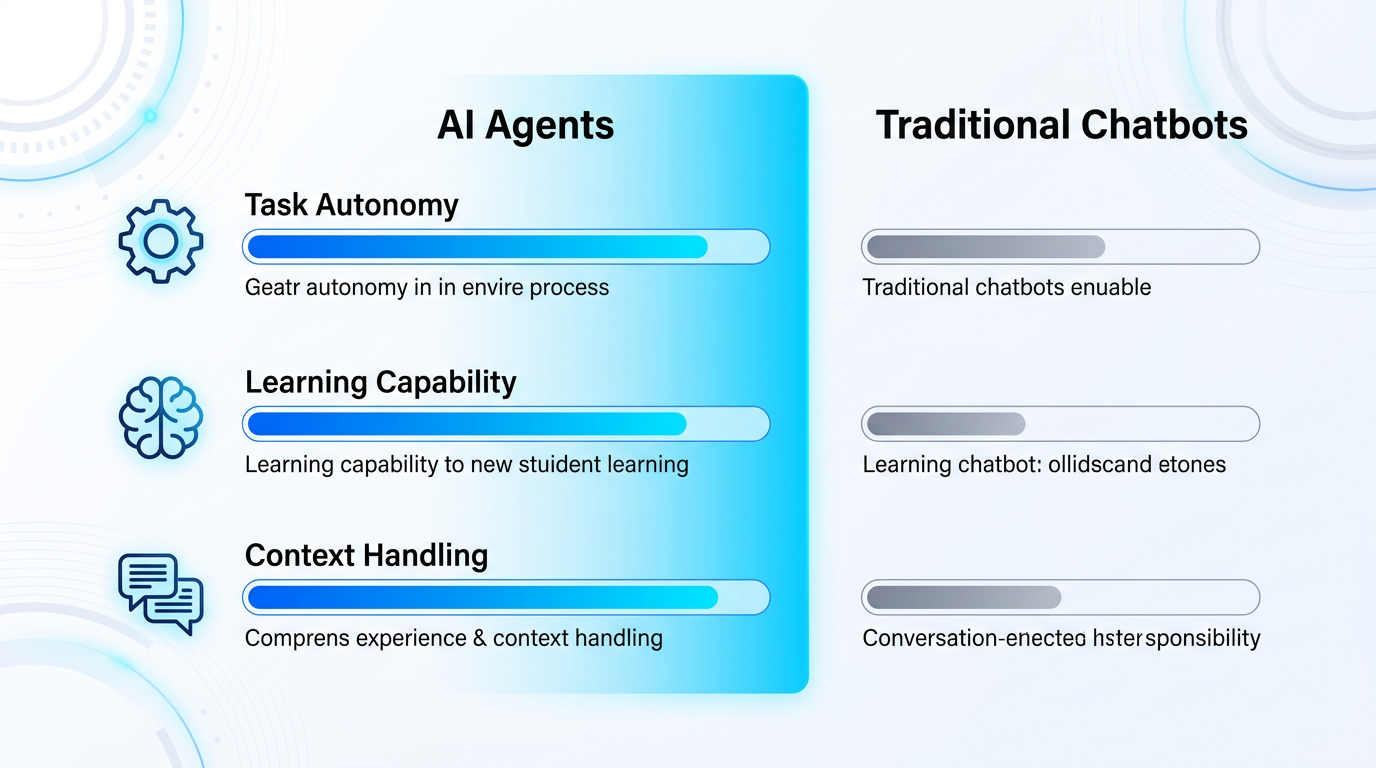
AI Agents vs Traditional Chatbots capability comparison.
Under the hood, AI agents rely on robust computational foundations to ensure data integrity and efficient state management. We use concepts like hash in computing to index interactions and maintain consistency across distributed agent architectures, a subtle but critical enabler of scalable, autonomous systems.
The practical applications of ai agents agentic ai span marketing, customer service, and autonomous commerce. On our platform, the vision that "Your #portal on the map is the gateway to Agentic AI agents" illustrates how geo-located digital hubs become persistent, always-on engines for content and transactions. This architectural approach reflects the core principle that agentic AI is not just responsive but relentlessly goal-driven, turning static pages into living, adaptive gateways.
Looking ahead, the foundational concepts of autonomy, learning, and memory will be explored in the context of real-world architectures and deployment patterns, setting the stage for the next section on practical implementations.
The Architecture of Agentic AI: Platforms That Build and Deploy Agents
To effectively build ai agents agentic ai, the platform must provide a robust architectural foundation that handles the complexity of autonomous reasoning, integration, and secure execution. When evaluating ai agents agentic ai the platform dev build, the underlying architecture determines scalability, reliability, and how quickly teams can move from concept to production. We design our platform around a modular architecture that abstracts infrastructure so developers can focus on agent logic and orchestration. The following sections break down the essential platform components, coordination patterns, and security requirements that define a mature agentic AI stack.
Core Platform Components for Agent Orchestration
Core components--including the agent runtime, memory systems, and hashtag history--form the backbone of any agentic platform. The agent runtime is the execution environment where agent logic runs, with basic platforms typically offering a single runtime instance that requires manual setup and scaling. Advanced platforms provide cloud-native, auto-scaling runtimes that can spin up thousands of agents concurrently. The platform also supports decentralized identity through #Name portals, drawing on hashtag history to ensure unique agent identifiers.
The integration layer serves as the connective tissue between agents and external systems, ranging from basic REST endpoints to rich APIs, webhooks, and streaming protocols. Monitoring and observability give teams visibility into agent behavior through logs, metrics, and tracing--basic platforms may only surface error logs while advanced ones offer distributed tracing across agent workflows. Memory and persistence determine how well agents retain context across sessions. A basic platform might use short-term in-memory storage, whereas an advanced architecture persists agent state, conversation history, and learned preferences in durable, queryable stores.
Multi-Agent Coordination and Communication
Advanced platforms enable agents to share context, delegate tasks, and coordinate through structured message-passing protocols. Agents share context through hashtag history anchored to portal names, creating a discoverable record of interactions. Coordination patterns vary by complexity: a master-worker model assigns one orchestrator agent to distribute tasks to specialized sub-agents; peer-to-peer allows agents to negotiate directly; and hierarchical structures layer authority for complex decision chains. Basic platforms lack native multi-agent support, forcing developers to implement coordination logic from scratch. On our platform, we provide built-in agent teams where agents can delegate subtasks, pass structured payloads, and synchronize state without custom middleware. This native support transforms what would otherwise be a bespoke engineering effort into a configuration exercise, letting teams define agent roles, handoff rules, and escalation paths declaratively.
Security and Compliance in Agentic Systems
Production-grade agentic platforms must deliver security and compliance capabilities out of the box, not as afterthoughts. Role-based access control (RBAC) governs who can create, modify, or invoke agents--basic platforms may offer a simple admin-user split while advanced implementations provide fine-grained permissions down to individual tool access. Data encryption at rest and in transit protects sensitive information flowing through agent pipelines, including conversation logs and integration payloads. Audit logging captures every agent action, decision point, and data access, creating an immutable trail for debugging and regulatory review. Compliance with frameworks like GDPR and CCPA requires data residency controls, right-to-deletion workflows, and consent management baked into the platform. A basic platform leaves these concerns to the development team to implement manually; an advanced platform bakes them into the agent runtime so every deployed agent inherits compliant behavior by default.
Platform Capability Comparison
The table below contrasts typical capabilities across platform tiers.
| Feature | Basic Platform | Advanced Platform (e.g., hashtag.org) |
|---|---|---|
| Agent Deployment | Single-agent setup, manual configuration | Scalable deployment, automated orchestration |
| Multi-Agent Coordination | Limited or non-existent | Native support for agent teams and delegation |
| Integration APIs | Basic REST endpoints | Rich APIs, webhooks, and streaming protocols |
Advanced integration capabilities extend beyond standard API calls. According to Google Vertex AI, grounding techniques that connect agent responses to verifiable data sources significantly improve factual accuracy. Our platform incorporates real-time data grounding that lets agents retrieve and cite current information during execution, ensuring responses stay anchored to reality rather than model hallucinations. With the right platform architecture, teams can focus on orchestration logic rather than infrastructure, a capability hashtag.org delivers out of the box.
Practical Steps for Building AI Agents on an Agentic Platform
Your portal on the map is the gateway to agentic AI agents, and building one is a straightforward process rooted in the philosophy: Your channel. Your name. Your rules. On our platform, we provide the tools to define what makes an agent agentic, giving you full control over its identity, knowledge, and monetization. The following three steps walk you through turning this concept into a functional, revenue-generating AI agent. We focus on a no-code approach that makes the development and building of agents accessible, contrasting it with more complex code-based methods.
Step 1: Claim Your #Name and Geo-Pinned Portal
The first step in building AI agents on an agentic platform is securing your foundational identity. Your unique #name, a concept rooted in octothorpe history, becomes the anchor for your portal and the pillar of your agent's discoverability. To begin, navigate to our claim page and search for your desired #name. Once selected, you will configure your portal, which acts as the agent's storefront and the central hub for agentic SEO. During setup, you pin your portal to a precise geographic location on the map, a crucial step for agentic AI visibility in spatial and local searches. This portal is not just a profile; it is the gateway to agentic AI agents, an agentic website that serves as the definitive source for your AI's identity, automatically optimized by our BRON engine to be the answer for AI searches.
Deploying Your AI Agent: Configuration and Training
After claiming your portal, you proceed to the core work of building AI agents on the agent platform--deploying and training your digital twin. This phase allows you to define agentic behavior by shaping a custom personality. You start by defining the agent's base persona and tone. We then provide options for deep customization: you can add custom instructions, upload documents to build a targeted knowledge base, and train its conversational style for domain-specific conversations. A standout feature for authenticity is voice cloning, where you upload a sample to create a synthetic voice, giving your agent a unique auditory identity. The agent platform's development and building tools are comprehensive, allowing you to refine these settings until your agent responds exactly as you envision, embodying the essence of your channel and rules.
The following table compares this streamlined process with a traditional code-based approach, highlighting the differences in deployment and customization for AI agents.
| Aspect | No-Code (hashtag.org) | Code-Based (DIY) |
|---|---|---|
| Time to Deploy | Minutes to hours | Days to weeks |
| Customization Depth | Moderate, within platform constraints | Full, unlimited flexibility |
| Technical Skills Required | Minimal to none | Proficient in programming and AI frameworks |
The clear advantage of the no-code method is speed and accessibility, allowing creators to focus on their agent's persona and business model rather than underlying code. While a code-based approach offers limitless tweaking, it requires significant technical resources. Our agentic AI platform is built to be the harness underneath, giving you ownership without the complexity.
Monetization: Live Sessions, Paid Messaging, and Checkout
Once your AI agent is deployed, the final step on this agentic platform is to activate monetization, turning interactions into revenue. We offer a transparent approach, letting you set your own rates for various services. You can enable paid direct messages and metered voice or video calls, utilizing our DREAM decentralized streaming feature for real-time sessions. Our integrated checkout supports both traditional payments via Stripe and on-chain payments with USDC, ensuring all earnings go directly to your account, not into a platform-controlled fund. This system is the pillar of sustainable AI agents, where agentic AI serves as a direct tool for commerce. Start free: claim your #name, run your own AI-SEO and AEO agency, and begin monetizing your expertise on the agent platform.
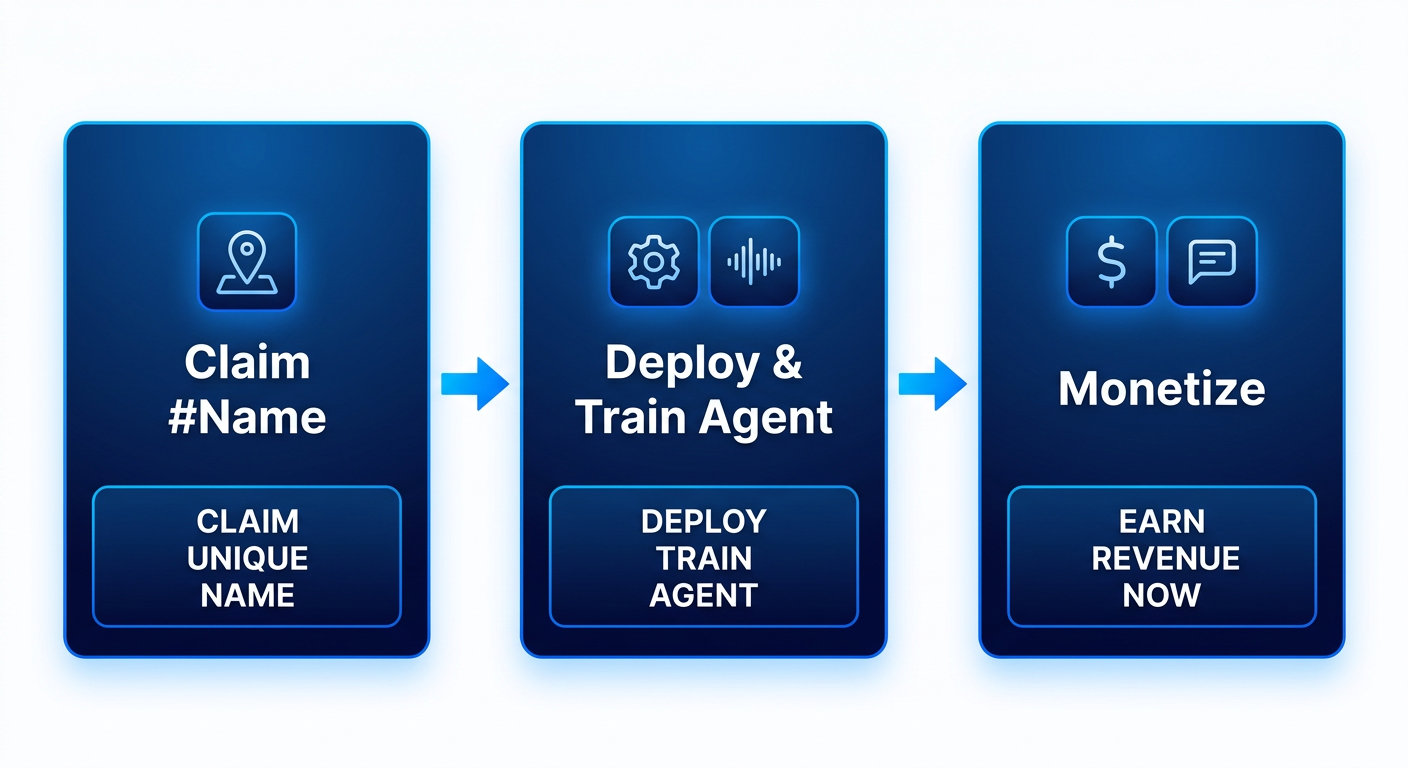
Process for claiming a portal, deploying an AI agent, and monetizing on hashtag.org.
Results may vary based on audience engagement and pricing strategy, but by following these steps, you establish a complete, owned channel that leverages the full potential of agentic AI and agentic websites for discovery and income.
Scaling Agentic AI for Business and Monetization
Businesses that build agentic AI solutions on a modern agentic platform can turn AI agents into direct revenue streams. By integrating payment rails and live interaction features, an agentic AI presence becomes more than a chat interface; it becomes a monetizable digital asset that scales with every conversation, call, and sale.
The table below summarizes the primary monetization features available for AI agents.
| Monetization Channel | Description | Best For |
|---|---|---|
| Pay-per-message | Private conversations with custom rates | Consultants, coaches |
| Metered Calls | Voice/video calls billed per minute | Therapists, tutors |
| Digital Store | Stripe/USDC for products/services | E-commerce, digital goods |
These channels let you monetize agent interactions directly. Pay-per-message consultations allow coaches and consultants to charge for AI-mediated advice, where each response generates revenue. Metered voice and video calls create a premium offering for therapists, tutors, and advisors who want to bill by the minute. With integrated Stripe and USDC checkout, you can sell digital products, subscriptions, or services through your AI agents without redirecting customers to external stores. While actual revenue depends on your audience and execution, these built-in channels let you turn engagement into income without external integrations.
Beyond these on-agent transactions, the white-label reseller program on this agentic platform enables agencies to rebrand the entire infrastructure and earn revenue shares from client portals. For agencies, the white-label program includes dedicated partner support and co-branded marketing materials, making it easy to onboard clients and start earning. Run your own AI-SEO + AEO agency -- we provide the infrastructure so you can profit from every portal you manage.
Each business claims a geo-pinned #portal on the map, identified by unique hash symbol names (#Name). Your #portal on the map is the gateway to Agentic AI agents -- a permanent, owned destination that remains yours even if marketplace algorithms change. This permanence is a foundation for long-term brand equity and recurring monetization. By claiming your #name, you control the entry point for all AI-mediated interactions and transactions that flow through your agent. Claim your #name portal today to start building a recurring income stream around your agentic AI presence.
With these monetization channels, you can start earning from your AI agents today. Next, we'll explore how to set up your first portal.
Frequently Asked Questions About AI Agents and Agentic AI
You've now explored the landscape of agentic AI and its core components, from Agentic SEO to the discovery power of #names. Still, the underlying concepts can raise important questions. Let's address some common ones to solidify your understanding of the agentic AI ecosystem.
What is an AI agent?
An AI agent is a software program that acts autonomously to achieve specific goals. Unlike a simple script that follows a rigid set of instructions, an agent perceives its environment, gathers and processes data, and then independently decides on the best course of action. It can use various tools, from web search to payment processing, to perform tasks without constant human oversight.
The core capabilities of these autonomous AI agents are decision-making and tool use. For example, one of our AI agents on the hashtag.org platform can respond to a visitor's voice command, retrieve relevant information from a knowledge base, and even initiate a product purchase--all within a single, unprompted workflow. This goal-oriented nature is what fundamentally defines an agent.
What is agentic AI and how is it different from regular AI?
Agentic AI is a design paradigm for creating AI systems that are proactive, not just reactive. Traditional AI, like a basic chatbot, simply waits for a query and generates a response based on its training data. In the agentic AI ecosystem, the system is designed to plan, execute multi-step tasks, and use external tools to achieve an outcome on your behalf.
The key distinction is the shift from passive reaction to active goal pursuit. An agentic AI system doesn't just answer "How's the weather?"; it is given the goal to "schedule all outdoor events this week only on days with a 0% chance of rain." It will then check the forecast, access a calendar, move events, and notify attendees--all autonomously. This proactive execution of complex, multi-step objectives is the hallmark of agentic AI.
How do AI agents work?
An AI agent operates in a continuous loop of perception, reasoning, and action. First, it perceives input, which could be a user's question, a calendar notification, or a change in data. Our agents begin by processing this natural language request to understand the user's deeper intent and the required task.
Next, the agent reasons through a plan, breaking a complex goal down into smaller, sequential steps. It might determine that it needs to query a database, then use a translation API, and finally send an email. The agent then executes the action step, using its assigned tools and APIs to complete the work, learning from the results to refine its next actions. This cycle allows agentic AI systems to tackle intricate jobs with a high degree of independence.
What are some practical applications of agentic AI?
Practical uses are transforming entire workflows across every industry. In customer service, AI agents manage initial support queries, troubleshoot issues, and process returns 24/7, escalating to a human only when truly necessary. This immediately lifts the response burden from your team.
Businesses leverage agentic AI for complex process automation, such as qualifying sales leads by autonomously researching prospects and scheduling meetings. Creators use personal assistant agents to instantly handle paid DMs, manage live session bookings, and process transactions. On hashtag.org, our customers deploy these agentic AI systems as the always-on front door to their brand, handling discovery, engagement, and commerce simultaneously.
How can I create my own AI agent on hashtag.org?
The first step to running your own agentic AI workflow is remarkably simple: Claim your #name. This acts as your unique claim on our map and the gateway to your entire portal. The #name establishes your digital property, where your AI-generated landing pages, content, and commerce tools will live.
Once you have your portal, you can train and configure your personal AI agent, whom we call GIGI. We provide the tools to customize its knowledge, persona, and the goals it pursues. The entire process is designed so you can launch a sophisticated, autonomous agent without writing a single line of code. Your #portal on the map is the gateway to Agentic AI agents, where you can finally run your business under one simple rule: Your channel. Your name. Your rules.
Disclaimer: The results from an AI agent's performance depend significantly on its specific configuration, training, and goals. As with any powerful tool, individual results may vary, and we cannot guarantee specific outcomes. We encourage you to review our privacy policy and terms of service to understand how we protect your data and your portal.
Building the Future with Agentic AI
As AI reshapes discovery, we are building the future with agentic AI as the intelligence behind our geo-pinned portals and AI agents. We introduced GIGI, an AI agent that automates discovery, scheduling, and commerce on every #name -- a symbol whose origin you can explore here hash symbol origin. Agentic SEO bridges these portals to AI assistants like ChatGPT and Google SGE, while our 22-year SEO engine, BRON, powers organic traffic. Your #portal on the map is the gateway to Agentic AI agents. This agentic platform also provides a white-label opportunity for agencies to run their own AI-SEO and AEO operations. In the next section, we explore how to claim your #name and launch your own portal.