Table of Contents
AI Shopping Agents: Transforming How Consumers Buy
AI shopping agents are transforming commerce by acting as proactive digital assistants that search, compare, and even complete purchases on behalf of consumers. Unlike reactive chatbots, these autonomous software entities leverage Agentic AI to understand intent and execute buying decisions, creating a new paradigm for customer engagement. For any business that captures attention online, the shift is profound.
At the core of these AI shopping agents is our Agentic AI stack, which orchestrates autonomous decision-making, real-time inventory checks, and payment flows—all while staying aligned with the brand’s persona. These autonomous sales agents deliver hyper-personalized product recommendations based on real-time behavior and preferences, dramatically shortening the path from discovery to conversion. Seamless automated checkouts remove friction, while conversational commerce—enabled by our persona-cloned voice and video agents—lets shoppers interact with a brand’s representative in real time, building trust at scale. For local businesses, this agentic commerce layer can be deployed through geo-pinned portals, turning every #name into an always-on shopping assistant. By continuously capturing and qualifying leads, the system empowers businesses to streamline their done for you lead generation efforts without manual intervention.
This is where our agentic commerce software steps in—transforming the AI shopping paradigm into a tangible growth engine for every business that claims its #name.
ChatGPT for Shopping
While the tools above excel at niche tasks, ChatGPT offers a broad, general-purpose shopping assistant.
Overview
As one of the most accessible ai shopping agents, ChatGPT from OpenAI assists with product research, price comparison, and purchase guidance. Its conversational interface allows users to discover products, compare prices, and receive recommendations in real time, making autonomous shopping discovery simple and efficient.
Features
ChatGPT’s capabilities position it among versatile autonomous sales agents, offering web browsing for product research and price comparison, deal discovery, and purchase summary generation. Its tools and extensions integrate with retailer data to surface relevant options. While it can guide users through checkout steps, it does not complete transactions. For users seeking a dedicated agentic ai platform, we at hashtag.org offer a comprehensive ecosystem that integrates payments and marketplace discovery, providing end-to-end agentic commerce.
Pricing
OpenAI offers transparent pricing: a Free tier with limited browsing, Plus at $20/month for priority access and extended context, Team at $25/user/month, and Enterprise custom plans.
Pros & Cons
Pros:
- Vast knowledge base and natural conversational interface.
- Accessible on multiple devices and platforms.
- Handles complex multi-step shopping queries efficiently.
Cons:
- May provide outdated or inaccurate product information.
- Lacks integrated payment or marketplace features for seamless purchase.
- Requires users to verify recommendations and complete purchases externally.
Overall, while ChatGPT stands out among ai shopping agents for research and discovery, it lacks the dedicated transaction layer of specialized platforms.
Best For
ChatGPT is best for individual shoppers who need a versatile research assistant for price discovery and product evaluation. Small ecommerce teams can leverage it for market intelligence. However, for large-scale automated purchasing or integrated marketplaces, dedicated agentic commerce software like our geo-pinned #name portals and persona-cloned agents provide a more robust solution.
Now that we’ve covered ChatGPT’s capabilities, let’s compare specialized agentic commerce platforms that integrate payments and marketplace features.
Google Shopping AI
Overview
Among the most prominent ai shopping agents is Google Shopping AI, which leverages machine learning to surface relevant products based on user query context, purchase history, and real-time price data. This AI-driven layer enhances product discovery and comparison for shoppers while helping merchants gain organic visibility in AI-generated carousels.
Features
Among ai shopping agents, Google Shopping AI provides product discovery and real-time price comparison. Its AI-assisted cart suggests complementary items—like a phone case when a phone is in the cart—acting as autonomous sales agents without guaranteed success. According to our analysis at Hashtag.org, AI citation frequency, driven by entity density, influences product visibility, and the platform’s local inventory features align with geo-pinned discovery trends.
Pricing
Merchants can list products for free via Google Merchant Center. Paid shopping ads offer premium placement for extended reach, with costs based on a bidding model.
Pros & Cons
- Pros:
- High potential for organic visibility in AI-generated product carousels, as products with high entity density are more likely to be cited.
- Free product listings provide low-barrier entry.
- AI-assisted cart improves the shopping experience.
- Cons:
- Limited branding customization compared to dedicated agentic commerce software.
- No guaranteed outcomes for traffic, conversions, or sales.
Best For
Google Shopping AI best suits businesses seeking maximum organic visibility through AI-generated product carousels. Its value shines in highly regulated industries like behavioral health, where LegitScript SEO for rehab centers complements AI-driven product visibility, and agentic commerce software adds deeper customization.
While Google Shopping AI offers broad organic visibility, other platforms provide more tailored agentic commerce experiences — as we’ll see next.
Amazon Rufus
Another notable entrant in the AI shopping assistant space is Amazon Rufus, an AI-powered tool integrated into the Amazon mobile app since early 2024. It showcases how ai shopping agents are transforming product discovery through conversational, personalized experiences.
Overview
Launched in early 2024, Amazon Rufus is an AI-driven shopping assistant built into the Amazon mobile app. It enables shoppers to explore products using natural language queries, delivering a more intuitive browsing experience. As a prime example of ai shopping agents in action, Rufus highlights the evolution of autonomous, conversational commerce.
Features
Rufus offers three core capabilities on the Amazon platform. First, conversational product search lets users ask detailed, natural-language questions. Second, product comparison summaries present side-by-side evaluations with key differences highlighted. Third, purchase recommendations draw on customer reviews and browsing history. These features make Rufus part of a new class of autonomous sales agents operating within a broader agentic commerce software ecosystem, guiding purchase decisions efficiently.
Pricing
Amazon Rufus is free for all shoppers using the mobile app. To appear in Rufus-generated answers, brands can optimize product listings and invest in Amazon Ads. Consumers pay nothing.
Pros & Cons
Consumers
- Pro: Easy product discovery via natural language and personalized recommendations. This simplifies the shopping journey.
- Con: Limited to Amazon's catalog; sponsored products may receive preferential placement, which can skew results.
Sellers
- Pro: May boost product visibility when listings are optimized for conversational search.
- Con: Discoverability hinges on Amazon's algorithm and ad spend, with no guaranteed results. Sellers must continuously adapt.
Overall, Rufus offers convenience but comes with trade-offs for both sides.
Best For
For Amazon sellers, Rufus provides a way to tap into conversational, AI-driven shopping queries. Within the evolving agentic commerce software landscape, autonomous sales agent software like Rufus rewards those who optimize product titles, bullet points, and backend keywords. Understanding where Rufus excels sets the stage for comparing it with other AI shopping assistants.
Perplexity Shopping
Overview
Perplexity Shopping exemplifies the rise of AI shopping agents, using real-time search to aggregate product listings with direct citations from retailer websites. It surfaces cited source links alongside each recommendation, letting shoppers verify claims independently. This approach shifts product discovery from static lists to a research-backed experience.
Features
The tool provides real-time product search, automatic price comparisons across multiple retailers, and direct source citations for every result. Autonomous sales agents are not yet mainstream, but Perplexity’s agentic retrieval mimics this behavior by synthesizing product data from multiple stores in seconds. Our own AI agents platform at hashtag.org also applies similar agentic retrieval for commerce use cases. Its frequent, transparent citations align with best practices for AI citation frequency we outline in our own guides—building user trust by showing where each detail originates.
Pricing
Perplexity offers a free tier with a limited number of Pro searches daily. The Pro subscription unlocks unlimited searches and access to advanced models for deeper product research.
Pros & Cons
Among its key strengths, Perplexity Shopping provides transparent citations, time-saving synthesis, and meaningful price comparisons across multiple retailers. However, its product filtering options remain limited, and the freshness of results depends on how recently third-party sources updated their data. While it generally surfaces competitive prices, we wouldn’t treat its output as a guaranteed lowest-price finder—smart shoppers should cross-verify when making high-stakes purchases.
Best For
Perplexity Shopping is best for shoppers who demand detailed, cited research behind recommendations rather than quick listicles. It appeals to users seeking an autonomous commerce platform that prioritizes transparency and verified sources. We see this as part of a broader shift toward agentic commerce software, where AI assists with informed buying decisions.
You.com Shopping
Overview
You.com's shopping assistant is a notable example of AI agents for ecommerce, offering conversational product discovery across multiple retailers simultaneously. Unlike hashtag.org's persona-cloned assistants that replicate a creator's voice or geo-pinned portals that tie commerce to specific locations, You.com's agent remains generic and globally accessible.
Features
The assistant supports conversational product search with natural language queries—ask "find the best noise-cancelling earbuds under $150" and it scans Amazon, Walmart, and others. Price alerts let shoppers set threshold targets; the agent notifies them when prices drop. Multi-source comparisons aggregate side-by-side results from major retailers, enabling instant evaluation. These AI shopping agents compare prices in real time, saving the effort of opening multiple tabs.
Pricing
Core shopping search is free. A Pro subscription removes ads and adds advanced filters, delivering a more comprehensive agentic commerce software experience.
Pros & Cons
Unlike autonomous sales agents locked into a single marketplace, You.com’s assistant works across multiple retailers without ecosystem lock-in, giving shoppers autonomy. Privacy is another advantage; the agent requires no personal data, minimizing tracking. However, its integration with smaller niche retailers is limited, and purchases cannot be completed in-app—users are redirected to retailer sites to finalize orders.
Best For
This assistant is best for privacy-conscious shoppers who want personalized, agentic product search without being tied to Amazon or Google Shopping. Its global, non-geo-anchored approach differentiates it from location-tethered alternatives such as hashtag.org’s geo-pinned marketing portals.
Klarna AI Assistant
Overview
Klarna’s AI shopping assistant is an in-app tool that combines buy now pay later (BNPL) flexibility with AI-driven product discovery and purchase tracking. At hashtag.org, we keep a close eye on ai shopping agents because they’re reshaping how consumers discover products and manage payments. By integrating credit options and real-time guidance, Klarna’s assistant reduces the friction between browsing and buying.
Features
Klarna’s AI assistant rests on three key features. First, BNPL integration allows shoppers to choose installment plans or instant credit right inside the app, lowering checkout abandonment. Second, personalized product suggestions tap browsing and purchase history to serve up items you’re likely to want; this mirrors the way autonomous sales agents learn from behavior. Third, built-in purchase tracking and payment dashboards keep every transaction visible, the kind of agentic commerce software orchestration we prioritize at hashtag.org. Together, these make discovery, payment, and monitoring seamless.
Pricing
The assistant is free for consumers. Merchants pay a transaction fee per sale, typically in the 3–6% range plus a small flat fee. There are no monthly subscription charges.
Pros & Cons
For merchants, the assistant can raise average order value through AI-driven upselling and reduce checkout friction, attracting BNPL-preferred customers. For shoppers, ai shopping agents like Klarna’s provide payment flexibility, personalized discovery, and easy tracking. However, merchants may become dependent on Klarna and fees can compress margins, while shoppers risk overspending if credit is too convenient. The assistant only works within Klarna’s app and merchant network, and its recommendations are not financial advice.
Best For
The assistant thrives for ecommerce businesses already offering Klarna payments, as well as those adding flexible BNPL for the first time. Mid- to high-price-point stores targeting Gen Z and millennials benefit most, because these audiences often seek credit alternatives over traditional methods. Within our own work on agentic commerce software, we’ve seen similar patterns where convenience boosts checkout completion.
Shopify Sidekick
Overview
Shopify Sidekick is an AI assistant developed by Shopify and currently available to select merchants. As ai shopping agents become more prevalent across e-commerce stores, Sidekick brings agentic commerce capabilities directly into the Shopify admin. The tool helps merchants manage tasks and get insights without leaving their dashboard.
Features
Sidekick offers three core features: automated product description generation, natural-language inventory queries, and a customer service agent that handles routine buyer questions. This agentic commerce software allows store owners to ask questions like “Which products are low in stock?” and receive real-time alerts. Among the ai shopping agents available in hosted e-commerce environments, Sidekick’s deep integration with Shopify’s product catalog and order data gives it a practical advantage for everyday store operations.
Pricing
Sidekick is included with standard Shopify subscriptions at no extra cost, but advanced AI add-ons may require higher-tier plans or separate charges. This pricing model keeps the core assistant accessible for most merchants.
Pros & Cons
Pros include significant time savings, reduced manual work, and faster customer response times thanks to Sidekick’s automation. However, the assistant’s dependence on Shopify’s ecosystem can be limiting for sellers who operate across multiple sales channels. Unlike autonomous sales agents that can work across various platforms, Sidekick’s outputs may require human review to ensure accuracy, and the AI can occasionally produce content that misses brand voice or context. As we emphasize in our own content guidelines, AI-generated output should always be reviewed before publishing.
Best For
Shopify Sidekick best serves small to medium merchants who want to automate repetitive tasks and improve customer service without hiring additional staff. While this agentic commerce tool works well within Shopify’s walled garden, businesses seeking cross-channel AI assistance may prefer a done-for-you approach. At Hashtag.org, we provide persona-cloned agents and agency services that operate beyond a single platform, offering an alternative to Sidekick’s built-in capabilities. Merchants evaluating agentic commerce software should weigh their need for simplicity against the flexibility of platform-agnostic solutions.
Zendesk Answer Bot
Overview
While many AI shopping agents emphasize lead generation and autonomous sales, Zendesk Answer Bot specializes in real-time customer support automation for online stores. Embedded directly within the Zendesk platform, it handles product-related inquiries, escalates complex issues, and guides shoppers through the purchase journey—acting as a 24/7 frontline agent.
Features
As an AI shopping agent, the bot automates ticketing: it answers common questions about shipping policies, order status, and returns, while routing more nuanced requests to human agents. Product recommendation features suggest relevant items based on chat history and browsing patterns. Integrated payment processing lets customers complete purchases in-chat, turning support interactions into revenue opportunities. In doing so, the bot acts as an autonomous sales agent for routine inquiries and transactions.
Pricing
Zendesk Answer Bot is offered on a per-agent subscription basis with a free trial. The pricing scales with Zendesk plans, making it suitable for small boutiques and enterprise retailers alike.
Pros & Cons
Pros: 24/7 availability, deep integration with Zendesk ecosystem, and built-in analytics. Cons: limited customization, platform dependency, and occasional accuracy issues with complex queries. Unlike persona-cloned AI assistants (a model we review in our guide), Zendesk provides a generic, one-size-fits-all experience. For businesses pursuing deeper commerce automation, dedicated agentic commerce software can enhance transaction handling and incorporate agentic SEO; we cover these strategies in our LegitScript guide.
Best For
Online stores already using Zendesk that want to improve first-response times and capture leads after hours. It’s a solid option for retailers seeking a unified support-and-sales interface without deploying a separate AI shopping agent, allowing teams to focus on complex cases.
Salesforce Einstein
Overview
Natively integrated into Salesforce CRM, Einstein enables AI-driven personalization and sales automation without third-party tools, making it a natural choice for large-scale ecommerce operations seeking ai shopping agents. By embedding AI directly into workflows, Einstein simplifies adoption for sales and marketing teams.
Features
- Predictive product recommendations: Analyze browsing history and purchase patterns to suggest items shoppers are likely to buy.
- Sales forecasting: Apply machine learning on pipeline data to predict deal outcomes, acting as an autonomous sales agent that prioritizes high-probability opportunities.
- Automated customer journeys: Trigger personalized paths based on AI-scored lead segments, nurturing prospects from interest to purchase.
Together, these capabilities make Einstein a robust platform for ai shopping agents in large-scale commerce, enabling retailers to deliver relevant, real-time experiences.
Pricing
Salesforce Einstein is included in select editions such as Enterprise and Unlimited, but advanced AI add-ons come at additional cost, typically ranging from tens to hundreds of dollars per user per month.
Pros & Cons
Pros
- Deep CRM integration across Sales, Service, and Marketing Clouds.
- Enterprise scalability with support for massive datasets and global operations.
- Strong personalization capabilities that improve conversion rates and customer loyalty.
Cons
- High total cost of ownership due to premium add-ons and advanced licensing tiers.
- Steep learning curve, often requiring Salesforce-certified administrators and developers.
- Limited out-of-the-box location intelligence, as our geo-pinned marketing portal guide highlights, lacking native geo-targeted campaign tools.
- Tightly coupled to the Salesforce ecosystem, restricting flexibility for non-Salesforce users.
Best For
Salesforce Einstein best serves large ecommerce operations with existing Salesforce ecosystems that require integrated sales and marketing automation. For location-based discovery, our agentic commerce software adds geo-pinned portals and autonomous brand agents (as detailed in our AI Agents Services), complementing Einstein’s CRM-centric AI and enabling always-on conversational commerce.
Intercom Fin
Overview
Intercom, a leader in customer communication, offers Fin as an AI agent for conversational commerce and support. Positioned among advanced AI shopping agents, Fin integrates natively with Intercom's platform to handle inquiries and transactions, giving businesses an always-on assistant that draws on existing help content to resolve customer needs.
Features
Fin functions as one of the leading autonomous sales agents, delivering concrete capabilities that streamline customer interactions:
- Automated response generation using a company's knowledge base
- Lead qualification workflows that identify sales-ready prospects
- Direct checkout integration so customers can complete purchases in-chat
- Customizable workflows that match brand-specific support paths
Pricing
Fin uses a pay-per-resolution model, where a charge occurs only when a customer's issue is fully addressed and marked resolved. This transparent approach ties cost directly to outcomes, though actual rates vary by usage volume and are scaled to match a business’s support volume.
Pros & Cons
As an agentic commerce software, Fin provides clear advantages alongside practical limitations:
- Pros: 24/7 availability, faster response times for common queries, seamless integration with Intercom’s support suite, and consistent brand voice across interactions.
- Cons: Difficulty handling complex multi-step issues that require human nuance, dependence on the Intercom ecosystem, and a learning curve when training the AI on niche product catalogs.
Best For
Fin is ideal for businesses seeking autonomous sales agents that manage both customer support and commerce within a single platform. It suits companies already invested in the Intercom ecosystem that want a fully autonomous assistant with direct payment routing to close transactions inside the conversation. Overall, Intercom Fin represents a notable entry in the agentic commerce landscape, offering businesses a way to automate sales and support conversations directly within their established communication stack.
AI Shopping Agent Comparison
Selecting the right AI shopping agents can shape your e-commerce strategy. We compare ChatGPT for Shopping, Google Shopping AI, Amazon Rufus, Perplexity Shopping, You.com Shopping, Klarna AI Assistant, Shopify Sidekick, Zendesk Answer Bot, Salesforce Einstein, and Intercom Fin to clarify differences in discovery, purchase, payment, and integration so you can match tools to business needs. The table below highlights each agent’s standout capabilities.
AI Shopping Agent Feature Matrix
| Tool Name | Discovery Method | Autonomous Purchase | Voice/Video Agent | Payment Integration | Pricing Model | Best For |
|---|---|---|---|---|---|---|
| ChatGPT for Shopping | Conversational search | Limited (external links) | Yes (voice mode) | No native payment | Subscription (Plus/Team/Enterprise) | General AI assistance |
| Google Shopping AI | Product search & comparison | No (redirects to merchant) | No | Merchant Center (free) | Free + Ads | Organic discovery |
| Amazon Rufus | Conversational product search | Yes (on Amazon) | Limited (text only) | Amazon Pay | Free for shoppers | Amazon marketplace |
| Perplexity Shopping | Cited research search | No (outbound links) | No | No native payment | Free / Pro subscription | Research-driven shoppers |
| You.com Shopping | Multi-source search | Limited (price alerts) | No | No native payment | Free / Premium | Privacy-focused users |
| Klarna AI Assistant | Product recommendations | Yes (with Klarna payment) | Limited (AI chat) | Klarna (BNPL) | Free / Merchant fees | Flexible payment sales |
| Shopify Sidekick | Store intelligence | No (management tool) | No | Shopify Payments | Included in plan | Store automation |
| Zendesk Answer Bot | Support-driven discovery | No (support only) | No | Zendesk payments (optional) | Per agent / usage | Customer support AI |
| Salesforce Einstein | Predictive recommendations | No (sales assist) | No | Salesforce Payments | License + add-on | Enterprise CRM AI |
| Intercom Fin | Conversational support | No (support & lead capture) | Limited (text/chat) | Stripe integration | Pay per resolution | Sales + support automation |
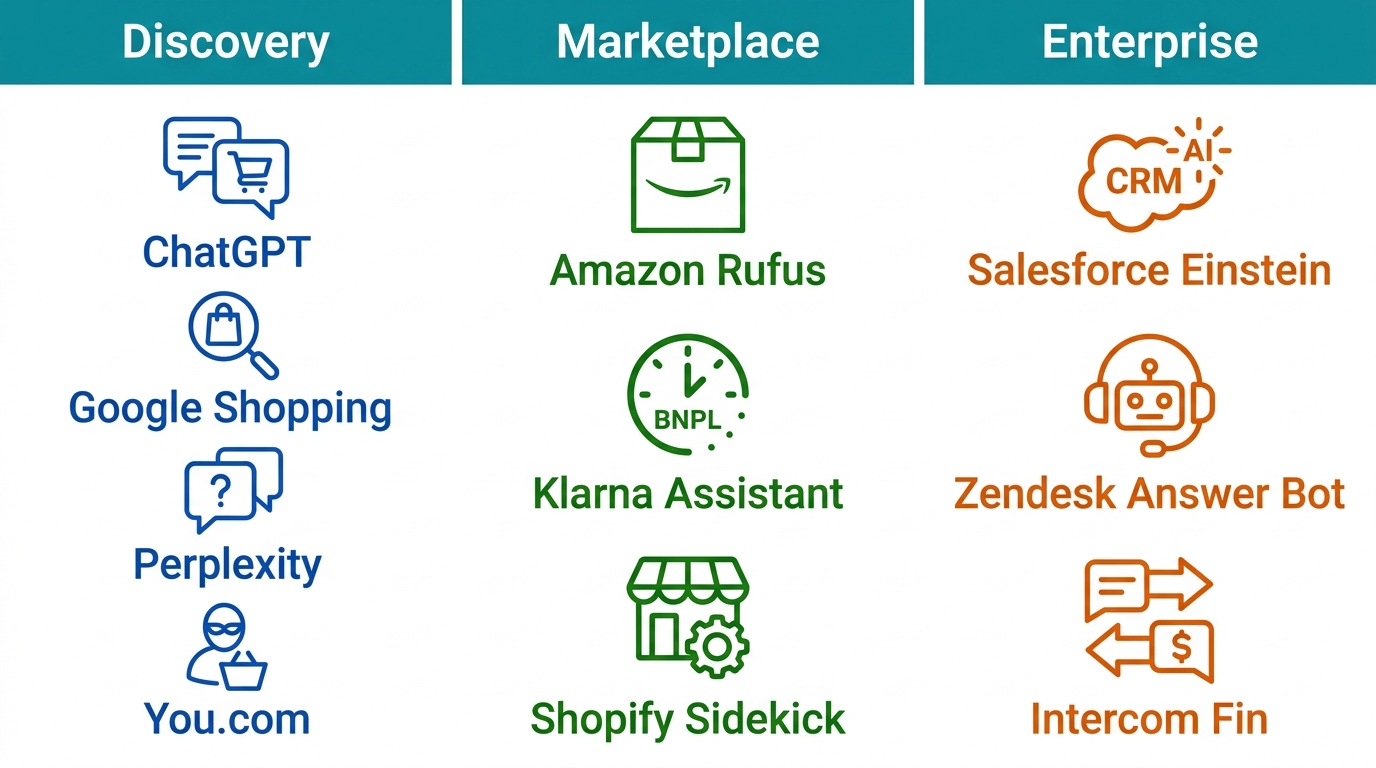
We see clear groupings. Marketplace-focused tools like Amazon Rufus and Klarna AI Assistant excel at autonomous purchase and integrated payments, making them ideal for direct sales. Google Shopping AI and Perplexity Shopping serve as powerful discovery engines, while Shopify Sidekick automates store management. For enterprise CRM and support, Salesforce Einstein, Zendesk Answer Bot, and Intercom Fin deliver customer intelligence and conversational assistance. You.com Shopping appeals to privacy-conscious users. As autonomous sales agents and agentic commerce software evolve, the right choice hinges on whether you need a discovery tool, a full autonomous shopping agent, or a support-oriented AI assistant. We recommend matching each column to your customer journey to avoid overinvestment and ensure a natural fit. This structured comparison gives you a pragmatic starting point.
 AI shopping agents compared by category: Discovery, Marketplace, and Enterprise.
Embracing Agentic Commerce Today
We are embracing agentic commerce today, and so should you. AI shopping agents are already reshaping how businesses interact with buyers—qualifying leads and processing transactions autonomously, not at some future point. Our blog post, “Best AI Sales Agents for Personal Branding,” illustrates how autonomous sales agents can drive brand growth and sales without constant manual oversight. Similarly, “Persona-Cloned AI Assistants for Creators Complete Guide” provides a step-by-step framework for setting up creator-focused AI assistants. These resources show that agentic commerce software is not theoretical; it’s operational. Your #portal on the map becomes the gateway to agentic commerce, enabling always-on engagement, persona-cloned voice interactions, and integrated payments directly within chat. The tools are ready—here’s how our platform makes it seamless. Outcomes depend on your actions and third-party algorithms. Explore our #portals, claim your #name, and train a persona-cloned agent to handle lead qualification, bookings, and payments on your behalf while you focus on creative work without needing constant oversight or technical staff.