Table of Contents
Understanding SEO Competitor Analysis
But to truly master SEO, you must first understand the competitive landscape. Understanding seo competitor analysis is the first step toward building a data-driven SEO strategy. It is the systematic evaluation of competing websites' search performance to uncover strengths, weaknesses, and actionable opportunities. We analyze both direct competitors—those offering similar products or services—and indirect competitors that target the same audience with different solutions.
Core areas we examine include competitor keyword research to pinpoint keyword gaps, backlink profile audits to uncover link-building targets, and content quality assessment to benchmark depth and structure. Sophisticated seo competitive analysis tools like Mangools and Ahrefs streamline this data collection—as our internal comparisons at hashtag.org highlight, each offers distinct advantages for different team sizes. Manual interpretation remains essential to turn raw data into strategy.
For organizations looking to scale this intelligence, our agentic SEO services weave continuous competitor insights into an AI-driven workflow. This approach supports informed content, link, and technical decisions without overpromising results.
Preparing for SEO Competitor Analysis
Before diving into the details, every effective review of the competitive landscape starts with proper SEO competitor analysis preparation. We recommend a structured approach that surfaces the right rivals, not just the most obvious ones — because actionable insights depend on accurate initial benchmarking.
Begin by identifying 3–5 primary competitors through SERP overlap and shared target terms. Our internal WordPress SEO guide emphasizes that competitor keyword research should reveal the exact phrases where you intersect, then drive the selection of direct competitors (same services/location) and indirect ones (overlapping keywords but different offerings). Collect baseline data — organic traffic estimates, top-ranking pages, and content topics — so your later gap analysis rests on a solid foundation.
Set up an AI SEO software or rank tracker to store domain authority, backlink counts, and keyword gap metrics. To determine which SEO competitive analysis tools fit your workflow, we have published a detailed comparison of mangools vs ahrefs. Cross-reference multiple sources and verify any AI‑generated data against our internal resources — incomplete intelligence leads to weak strategic decisions. Once these baselines are captured, you are ready to move from preparation into the hands‑on execution of your analysis.
Identify Your True SEO Competitors
A proper seo competitor analysis reveals which domains actually compete for your organic traffic—not just companies in your industry. True SEO competitors are sites that rank for your core keywords, regardless of business category. Competitor keyword research identifies shared ranking terms, but the real benchmark is whether a domain’s organic pages address identical search intents and fight for the same URL positions.
- Domains ranking for the same target keywords.
- Overlapping organic landing pages.
- Direct URL competition for a searcher’s click.
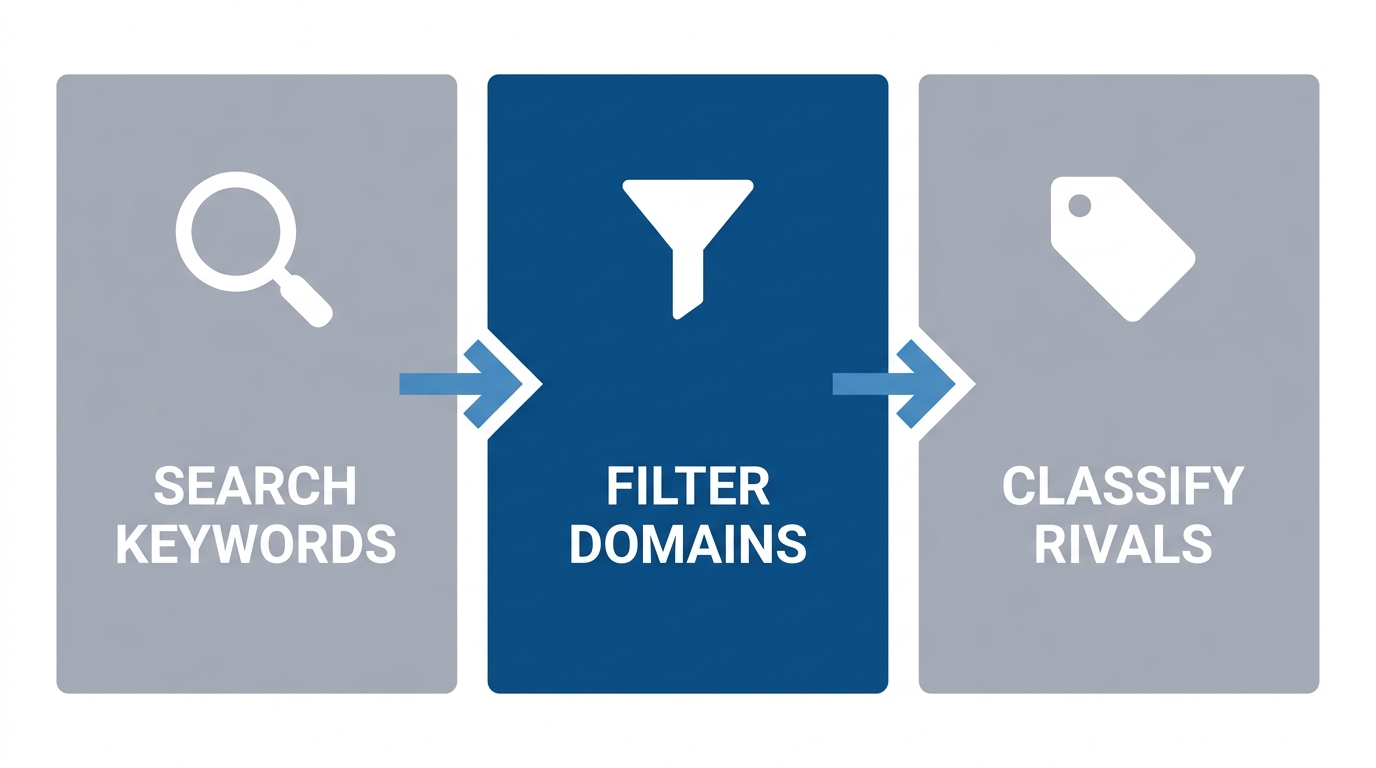
Identify your true SEO competitors in three clear steps.
A recipe blog can outrank a bakery—so look past obvious business names. As an seo competitive analysis tool, AI Market Intelligence clusters competitors by content territory and semantic overlap. Enter a seed keyword to generate a ranked list of competing domains in under 60 seconds. Refresh your seo competitor analysis quarterly; search environments shift. Review AI-generated competitor lists manually. Use hashtag.org’s AI Market Intelligence, grounded in our extensive hashtag history and best practices, to instantly surface your true SEO competitors.
Analyze Their Keyword Strategy
In seo competitor analysis, knowing which high-value terms your rivals target is essential for closing visibility gaps. This process moves beyond guesswork by applying data-driven insights to uncover the specific keywords that attract qualified traffic to their pages, and reveal buyer intent and seasonal patterns.
Our AI Market Intelligence streamlines the work for competitor keyword research, automatically extracting and grouping keywords from competitors’ content. Unlike manual reviews, these seo competitive analysis tools surface patterns and long-tail phrases hidden in bulk data, helping you focus on terms with real conversion potential.
To refine your list, cross-reference uncovered gaps with independent benchmarks. For instance, marketing association resources like the AMA offer industry data that can confirm whether a keyword warrants investment, ensuring your strategy aligns with broader market trends and prioritize opportunities that match our audience, timelines, and goals.
Evaluate Their Content Quality and Structure
Now that you’ve identified your competitors and selected your tools, the next step in our seo competitor analysis is to examine the actual content quality and structure of their pages. We move beyond basic metrics to understand what makes their content resonate.
Key dimensions we evaluate include:
- Heading hierarchy – Clear H1–H3 structure that signals topical depth?
- Content depth – Fully covers subtopics or only skims the surface?
- Keyword placement – Primary terms integrated naturally, including first 100 words?
- Multimedia – Value-adding or cluttering images, videos, infographics?
- Freshness – Publication and last-updated dates to gauge relevance.
- Internal linking – Related resources linked contextually within the body.
These elements together shape how users and search engines perceive a page.
A thorough seo competitor analysis goes beyond keyword ranks—this content quality audit reveals the structural factors that make pages successful. By incorporating competitor keyword research data, we can spot gaps and opportunities. While SEO competitive analysis tools like Mangools and Ahrefs can speed up the audit, the evaluation criteria are tool-agnostic—as we highlighted in a recent comparison on hashtag.org. This structured assessment directly feeds into the improvements we’ll make to your strategy.
Assess Their Backlink Profile
Once you have identified your main competitors, the next critical step is to assess their backlink profiles. A thorough seo competitor analysis reveals where rivals earn their links, helping us uncover opportunities for our own strategy. We start by examining the quantity and quality of referring domains, then categorize the link types—editorial, guest posts, directories—to understand their primary acquisition tactics. Anchor text diversity, including competitor keyword research, points to target keywords and potential over-optimization risks. Monitoring the growth trend of new links indicates how actively they are building.
Tools like Ahrefs or Semrush can check these metrics manually. However, Agentic SEO platforms like our own BRON engine now automate and continuously update this competitive link intelligence, streamlining backlink audits. Understanding where competitors earn their links will inform your own acquisition strategy and tactics, which we cover next.

Review Their Technical SEO Foundation
Now that we have identified their content strategy, let's examine how their site is built technically. A thorough seo competitor analysis evaluates the underlying architecture that affects both user experience and search engine visibility. By understanding where competitors excel or falter technically, we can prioritize our own Agentic SEO improvements with greater clarity.
- Measure site speed with Google PageSpeed Insights, paying close attention to Core Web Vitals and Largest Contentful Paint (LCP) scores to gauge real-world performance.
- Test mobile responsiveness rigorously using Google's mobile-friendly test and multiple physical devices to ensure a seamless experience for all users.
- Assess crawlability by inspecting the structure of their XML sitemap and the directives in their robots.txt file for unintentional blocks.
- Verify their SSL certificate is valid and that all pages enforce HTTPS, confirming that user data and site integrity are protected.
- Scan key pages, such as product or service pages, for structured data (schema markup) that enhances rich results in search engines.
- Look for correct implementations of canonical tags and, as part of effective competitor keyword research, review their URL architecture. Utilize seo competitive analysis tools to check for proper 301 redirects and hreflang tags if the site targets multiple languages. As the WordPress SEO Guide by Hashtag.org highlights, these technical details remain fundamental. With a clear picture of their technical foundation, we can now move to analyzing their authority and trust signals.
Monitor Their Social Media Presence
A key part of any seo competitor analysis is monitoring rivals’ social channels. Once you have a list of key competitors, the next step is to track their social media activity for real-time signals. We recommend identifying which platforms each competitor uses—LinkedIn, X, Instagram, or Facebook—and noting their posting frequency. Next, analyze the type of content they share, such as blog links, videos, and user-generated posts. Pay attention to engagement metrics like likes, shares, and comments to see what resonates. This data feeds into your broader competitor keyword research as you extract trending hashtags and captions. Leverage seo competitive analysis tools like hashtag.org’s AI Visibility Monitoring to capture brand mentions and sentiment. According to the American Marketing Association, ethical monitoring practices rely on publicly available data. Try our AI Monitoring to automate this process so you can focus on actionable insights. The social data you collect will directly feed into your competitor keyword research, which we cover next.
Compile and Prioritize Your AI Visibility Insights
With your competitor data in hand, now it’s time to compile your insights and prioritize the actions that will move the needle. Through our Agentic SEO platform, we have seen rivals ranging from regional service businesses to established content creators surface in AI-generated answers, each with distinct strengths—such as well-optimized #name portals or thorough keyword coverage—and weaknesses like slow mobile pages or outdated entity schema. Use that intelligence to categorize your opportunities:
- Immediate Fixes: Claim and verify your #name portal if missing. A missing geo-pinned portal is the quickest route to invisibility in map-based AI results, and correcting it immediately strengthens your brand’s answer-engine footprint.
- Short-Term Gains: Use competitor keyword research to identify content gaps your rivals are not addressing. Publishing high-entity, question-based pages aligned with those gaps can lift your citation rate in generative search within weeks.
- Long-Term Strategy: Move beyond reactive fixes and into agent-first optimization. Leverage our AI Market Intelligence tools to train a persona-cloned agent with Nexus, building a proactive, always-on presence that engages users directly through voice and chat.
Each priority action above ties directly to an expected impact on AI visibility: better geo-context for local discovery, expanded content coverage for answer engine optimization, and deeper agent readiness for conversational commerce. For a full walkthrough of how these steps integrate into your stack, consider our Agentic SEO capabilities. We recommend documenting your baseline metrics now so you can measure the ROI of every change. Ready to begin? Schedule a free AI Visibility Scan or strategy session with our team, and let’s turn your competitive intelligence into a clear execution roadmap.
Overcoming Obstacles in Competitor Analysis
However, even the best SEO competitor analysis can hit roadblocks. At hashtag.org, we see marketing teams struggle with the overwhelming volume of data that modern competitive landscapes generate. The right techniques, paired with intelligent tools, can cut through the noise and turn raw data into actionable strategy.
Data Overload: Tracking Too Many Competitors. It is tempting to cast a wide net, but that often leads to paralysis. Our solution is ruthless prioritization — narrow your focus to three to five direct rivals. To monitor them efficiently, consider a hashtag-based tracking approach. As our knowledge base explains, a hashtag is a clickable label that aggregates related conversations. Watching a competitor’s branded campaign tag, for example, can surface their engagement spikes without requiring you to manually scroll through every post.
Manual Monitoring: The Time Drain. Competitor keyword research is vital, yet doing it by hand eats hours better spent on strategy. Automated intelligence gathering solves this. AI market intelligence tools, like those available through our platform, continuously scan for shifts in a rival’s messaging and keyword focus. These agents filter the signal from the noise, delivering concise briefs instead of endless spreadsheets and freeing your team to act on insights rather than just compiling them.
Stale Data: Relying on Outdated Snapshots. A report from last quarter is history. In a fast-moving market, you need real-time competitive intelligence. Integrating AI-driven feeds ensures your view of the competitive landscape is always current. This allows your benchmarks to reflect what rivals are doing right now — not what they did three months ago — so your SEO competitive analysis tools actually support proactive decision-making.
By embracing these focused solutions, you move from reactive data hoarding to proactive strategic planning. The goal is not to collect every data point but to surface the actionable insights that guide your positioning. Our geo-pinned #name portal ecosystem is built to centralize this intelligence, giving you a single command center for competitor insights without overcomplication.
Now that we have cleared the common hurdles of data and time management, let us put these competitor insights to work with a step-by-step process for building a responsive strategy.
Turning Analysis into a Competitive Edge
Once you have gathered competitive intelligence, the real value lies in applying those insights strategically. Effective SEO competitor analysis provides the raw data, but the sustainable advantage comes from transforming that data into decisive action. According to American Marketing Association frameworks, sustainable competitive advantage stems from continuous market intelligence, and we believe your digital presence should operate no differently.
Our approach begins with competitor keyword research to identify content gaps. By cross-referencing a rival's high-ranking pages against your own keyword portfolio, we can target underserved long-tail phrases. We also monitor competitor ranking movements weekly for sudden gains or losses, using those signals to adjust content freshness and link-building priorities. This allows you to outmaneuver rather than just react.
We then deconstruct backlink profiles to find authoritative domains linking to competitors but not to you, enabling personalized outreach campaigns. Using tools like seo competitive analysis tools, we compare topical authority clusters to spot weak areas where additional pillar content can close the gap. These strategic priorities set the stage for the tactical actions we cover next, establishing your channel as the authoritative voice in your niche.