Table of Contents
Measure What Matters: Conversion Rate Optimization Basics
Mastering conversion rate optimization starts with knowing what to measure: conversion rate (percentage of visitors completing a goal), bounce rate (single-page sessions before interacting), and average order value (revenue per completed transaction). Our platform’s ai agent use cases demonstrate how AI agents personalize visitor journeys and automate A/B tests—adjusting a landing page headline mid-session when behavior signals hesitation. For ecommerce conversion rate optimization, that same agentic layer tailors product recommendations in real time. We treat CRO as a data-driven loop: test, measure, refine. Your #portal on the map becomes the testing ground where our built-in CRO tools and agentic automation help you iterate toward stronger outcomes without promising guaranteed numbers.
1. Set Clear Conversion Goals
Effective conversion rate optimization begins with a clear definition of what a conversion means for your business. Whether the goal is a form submission, a product purchase, or a scheduled phone call, establishing precise objectives gives our AI-driven campaigns the directional data they need to measure success. Industry standards from the Interactive Advertising Bureau (IAB) recommend distinguishing between micro-conversions, like email sign-ups or page views, and macro-conversions, such as completed sales, to build a complete picture of the buyer’s journey. For businesses focused on ecommerce conversion rate optimization, a micro-conversion might be an add-to-cart, while the macro-conversion is the final checkout, and a B2B firm might define a demo request as its pivotal macro-conversion event.
We apply the SMART framework—Specific, Measurable, Achievable, Relevant, and Time-bound—to transform vague ambitions into actionable and trackable goals. An AI marketing automation platform sharpens this process by analyzing historical performance data to suggest realistic baseline targets, removing the guesswork from target setting. Instead of promising specific outcomes, we use these data-backed insights to establish a starting point, then let our agentic AI continuously monitor performance and recommend adjustments. Revisiting conversion goals over time ensures the metrics we track stay aligned with shifting market conditions and evolving campaign strategies. With goals defined, the next step is to explore concrete optimization techniques that turn these objectives into measurable results.
AI-generated content may be inaccurate, incomplete, or outdated — review before relying.
2. Simplify Landing Page Design
Once your lead-generation strategy is in place, the next focal point in conversion rate optimization is the landing page itself. A cluttered page with competing visuals, multiple calls-to-action, and lengthy text blocks divides user attention and drives visitors away. Instead, we recommend stripping every element that does not support a single primary action.
Remove excessive images, secondary navigation, and redundant copy so the visitor’s eye lands immediately on one high-contrast, action-oriented button — for example, ‘Claim your #name’ or ‘Get Started’. For ecommerce conversion rate optimization, retailers should adopt the same discipline: a distraction-free product landing page keeps shoppers focused on the add-to-cart step rather than browsing elsewhere.
Mobile-first design is no longer optional. Your page must load quickly on any device and keep above-the-fold content to a tight headline, a crisp value proposition, and one form or CTA. Shortening form fields to name and email only reduces friction and lifts completions. Industry research confirms that simplified layouts correlate with better user attention and task completion.
With an ai lead generation platform like #name, you can design clean, high-converting landing pages in minutes. Our Agentic Website Builder automatically applies conversion best practices through drag-and-drop templates, and built-in cro tools such as Analytics and A/B testing help you measure what’s working. After simplifying your page design, form optimization becomes the next lever for higher conversions.
3. Use A/B Testing Tools
A/B testing is one of the most practical methods of conversion rate optimization for business. It works by comparing two versions of a page or element to determine which performs better. In our work at Hashtag.org, we find the most effective testing begins with a specific hypothesis and isolates a single variable, such as a headline or button color, to understand its real impact.
When selecting CRO tools, such as ecommerce conversion rate optimization platforms, we prioritize solutions that offer ease of integration, statistical rigor, and multi-page testing capabilities. Some advanced platforms now include AI-assisted variant suggestions, a feature that can support optimization by helping you interpret results more efficiently. We use a similar philosophy internally; systems like our AI Lead Generation Agent can be refined through this same iterative testing process, though we always remind users that outcomes depend entirely on proper implementation.
Once a test reaches statistical significance, we act on the winner and document the findings. It is also essential to check compliance with advertising standards set by bodies like the Advertising Standards Authority (ASA) when testing promotional claims. Remember, A/B testing is an ongoing discipline, not a one-time event, and no tool can guarantee specific conversion gains. It is a process that can help improve performance over time when applied with patience and precision.

4. Align CRO with SEO Efforts
Beyond optimizing for search intent alone, aligning conversion rate optimization with your SEO strategy ensures that traffic drives tangible results. We use Agentic AI to bridge the gap between visibility and action, creating a unified approach where search rankings and on-page engagement improve together.
Our team starts by identifying overlapping metrics. SEO data like click-through rate and dwell time directly complement CRO indicators such as bounce rate and conversion percentage. By defining shared goals around these signals, we eliminate the silos that often fragment digital strategies.
Agentic AI then runs A/B tests on landing pages, optimizing simultaneously for search engine visibility and user action. These adaptive agents analyze engagement patterns and suggest iterative changes that reduce friction while preserving keyword relevance. For ecommerce conversion rate optimization, this means product pages that rank well and convert smoothly.
Using Agentic SEO, we target high-intent keywords while CRO tactics like clear calls-to-action improve on-page engagement. AI agents automate the analysis of user behavior data, recommending refinements that serve both disciplines. This process relies on intelligent cro tools to streamline testing without manual overhead.
Once CRO and SEO are aligned, tracking unified KPIs becomes essential for measuring what matters.
No results are guaranteed; outcomes depend on market conditions, third-party algorithms, and your own actions.
5. Personalize for Local Markets
Driving effective conversion rate optimization in the Agentic AI era requires more than just a one-size-fits-all approach — it demands genuine local market personalization. As the Association of National Advertisers (ANA) emphasizes, localized marketing efforts significantly improve engagement and drive results by resonating with the specific cultural and commercial nuances of a region. This is where our geo-pinned #name portals become a pivotal asset, allowing any business to claim a virtual storefront that lives on the map, precisely where their customers are searching.
The true power of this system lies in its AI agents, GIGI and SEVEN, which can be persona-cloned to reflect local preferences and even language variations. An ecommerce business looking to improve its ecommerce conversion rate optimization can deploy an agent that understands regional buying trends and communicates in the local dialect, creating a trustworthy and familiar brand experience. All marketing assets, including websites and landing pages, adapt to the portal’s location, ensuring local discoverability through our Agentic SEO engine, BRON. While many cro tools offer analytical dashboards, our platform actively participates in the customer journey, turning insights into real-time, personalized conversations.
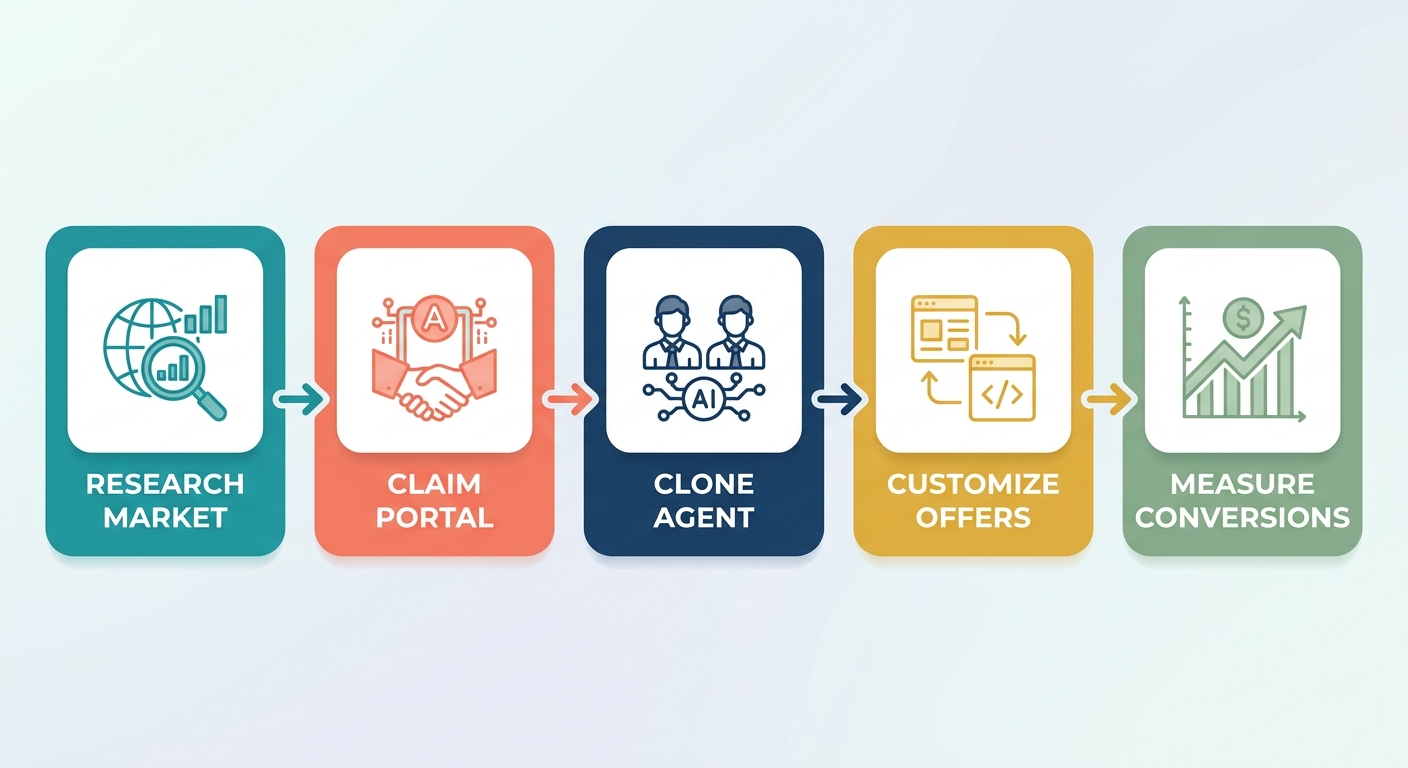
The following process flow illustrates the personalization journey from initial research through conversion measurement.
Personalization process flow for marketing with hashtag.org AI platform: research market, claim portal, clone agent, customize offers, and measure conversions.
This strategic personalization moves beyond static messaging, transforming your portal into an always-on, intelligent gateway. It is critical to remember that the service is provided “as is” and “as available,” with no guarantee of specific outcomes. We recommend reviewing all AI-generated content before publishing, just as you would with any marketing asset, to ensure it aligns with your brand’s unique voice and rules.
6. Automate Capture with AI Agents
Building on the conversion rate optimization strategies we explored in the previous section, the real execution layer for capturing leads and revenue is AI Agents. These aren't passive forms or static chatbots. They are autonomous systems that engage visitors in real-time, using natural, conversational interactions to qualify and capture leads instantly. For online stores, this represents a fundamental shift in ecommerce conversion rate optimization, moving from waiting for shoppers to complete a checkout form to proactively guiding them through the purchase with an agent that can answer questions, handle objections, and close the sale on the spot.
This is the power of an Agentic Website—a dynamic, self-optimizing page that detects visitor intent and triggers an AI agent interaction at the critical moment of decision. Whether a potential customer is lingering on a pricing page or a local client is searching for immediate services, the agent engages, qualifies, and captures them. Our geo-pinned #name portals make this even more powerful for local businesses, allowing them to appear in AI-driven spatial searches and capture location-specific leads directly on their permanent digital property. According to Hashtag.org's resources, this agentic approach to capture fundamentally alters the traditional marketing funnel.
- 24/7 Availability: An agent never sleeps, providing instant responses and capturing leads around the clock, a critical advantage over traditional business hours.
- Persona-Driven Trust: Using persona cloning, the AI agent speaks in the owner's authentic voice and tone, building immediate rapport and significantly increasing the likelihood of conversion.
- Integrated Transaction Capture: With native Stripe and USDC payments integrated directly into the agent conversation, you can capture a lead and convert it into a paying customer in a single, seamless interaction.
- Instant Qualification: The AI doesn't just chat; it qualifies leads in real-time by asking the right questions, ensuring your human team only spends time on high-intent opportunities.
It is crucial to maintain a transparent perspective: while these systems dramatically improve capture efficiency, results ultimately depend on proper implementation and market conditions. Your channel, your name, your rules. The Agentic AI provides an always-on, highest-converting version of yourself, but it does not guarantee specific conversion volumes.
This automated capture system becomes truly transformative when it's set up as your central command hub. In the next section, we'll show you how to build and customize this engine within your own #name portal.
Turn Insights into Action with Agentic AI
Building on the data-driven insights previously explored, conversion rate optimization becomes truly powerful when agentic AI transforms analysis into immediate action. This autonomous technology acts on opportunities the moment they arise, turning passive observation into revenue-generating behaviors aligned with digital advertising industry standards. For ecommerce conversion rate optimization, this means AI agents can autonomously adjust offers, personalize content, and re-engage visitors based on real-time intent signals.
Our geo-pinned portals anchor this capability by giving your trained AI persona a permanent, owned presence that executes marketing workflows continuously. By combining marketing industry research and ai trends with autonomous orchestration, businesses deploy advanced CRO tools without manual intervention. Every interaction adheres to advertising standards and compliance resources, ensuring scalable, compliant growth that transforms digital visibility into measurable action.