Table of Contents
- The Next Frontier in Web Design: Trends Defining 2026
- Core Principles: Minimalism, Immersive 3D, and AI in Modern Web Design
- AI-Powered Web Design: The Rise of Agentic and Generative Tools
- Implementing Web Design Trends in 2026: A Practical Guide
- Web Design Trends for Small Businesses: Budget-Friendly Adoption in 2026
- Frequently Asked Questions About Web Design Trends 2026
- Embrace the Future: Harnessing Web Design Trends for 2026
The Next Frontier in Web Design: Trends Defining 2026
Web design trends for 2026 are being redefined by agentic AI, moving beyond static pages to proactive, conversational experiences. Across the industry, three core directions in web design have emerged: agentic AI integration, which transforms sites into autonomous brand representatives; immersive 3D web design, which creates spatial, interactive environments; and personalized owner-claimed portals, which anchor a brand’s identity to a specific digital location. Together, these emerging web paradigms mark a fundamental shift in how businesses connect with audiences.
Our agentic web platform natively unites these three trends through geo-pinned #name portals. Each #portal combines AI agent capabilities with agentic SEO, giving owners a discoverable, always-on presence. The hash symbol in computing has a long history as a marker of categorization and identity — a role it now fulfills in our platform, where a claimed #name becomes the anchor for AI-driven engagement. This intersection of identity and intelligence makes ai-powered web design both functional and personal. As our founder’s 22 years of SEO craft informs our BRON engine, every portal is built to be found by both human users and AI systems.
Agentic SEO, sometimes called Generative Engine Optimization, is a new discipline focused on optimizing websites for AI discovery. It ensures your content is cited, summarized, and surfaced by autonomous agents and large language models. GIGI, our persona-cloned AI agent, demonstrates this in practice: trained to speak in your voice, GIGI engages visitors through live voice and video streaming, initiates conversations, pushes updates, and transacts on your behalf. It is important to note that outcomes depend on third-party algorithms and market conditions — no specific ranking or traffic is guaranteed. Your channel. Your name. Your rules. These 2026 design directions turn every website into a proactive gateway that captures leads and converts interest into real revenue.
In the next section, we outline exactly how to Claim your #name and activate these capabilities for your brand.
Core Principles: Minimalism, Immersive 3D, and AI in Modern Web Design
The foundational web design trends 2026 are converging around three powerful and distinct principles. The first, minimalist design, prioritizes clarity through generous white space and a strict content hierarchy. This approach reduces cognitive load for visitors and ensures fast loading times, making it ideal for content-heavy sites like blogs and portfolios. At hashtag.org, we see accessibility as a core function of this philosophy, not an afterthought. Following best practices from our internal guidelines ensures designs remain inclusive for users who rely on assistive technologies like screen readers and keyboard navigation.
The second principle, immersive 3d web design, moves beyond flat interfaces to create depth and interactivity. This technique uses three-dimensional visuals to build memorable, engaging experiences that tell a story—think virtual product showcases or interactive real estate walkthroughs. However, this high level of visual storytelling comes with significant implementation complexity, requiring specialized assets and rigorous performance optimization to ensure a smooth user experience on all devices.
In contrast, ai-powered web design introduces a new paradigm of adaptive intelligence. This third principle leverages automation to personalize interfaces in real time, creating experiences tailored to individual user behavior. This technology excels in dynamic environments like e-commerce and lead generation, where interfaces can adjust product showcases or calls-to-action instantly. The complexity is moderate, typically managed through platform integrations or APIs, rather than building complex 3D assets. Understanding the history of the hashtag helps contextualize how modern AI agents personalize user portals, evolving from a simple categorization tool into a cornerstone of digital identity that AI now leverages for discovery.
The following table compares these three foundational trends across key design dimensions.
| Aspect | Minimalist Design | Immersive 3D | AI-Powered Design |
|---|---|---|---|
| Focus | Clarity, white space, content hierarchy | Depth, interactivity, visual storytelling | Automation, personalization, efficiency |
| User Experience | Fast loading, low cognitive load | Engaging, memorable, processing power | Adaptive, tailored, may reduce control |
| Implementation Complexity | Low to medium | High (3D assets/optimization) | Medium (Platform/API integration) |
| Best For | Content-heavy sites, portfolios | Showcases, gaming, real estate | E-commerce, lead generation |
These distinctions highlight how modern web design is not a one-size-fits-all practice. The choice between minimalism's clarity, 3D's immersion, and AI's personalization depends entirely on a project's goals. The most effective applications of web design trends 2026 often come from layering these approaches, such as using an AI-driven personalization engine on a clean, minimal interface to create a uniquely adaptive and unobtrusive user journey. We will explore these practical, layered applications in the next section.
AI-Powered Web Design: The Rise of Agentic and Generative Tools
Web design in 2026 is being transformed by AI-powered tools. Among the key web design trends 2026, agentic and generative AI are reshaping how websites are created, managed, and monetized. At Hashtag.org, we’ve built our #name portal—rooted in the origin of hash symbol—as a gateway to agentic AI.
Only Hashtag.org Agentic AI offers live voice/video (DREAM) and integrated payments—enabling an autonomous revenue engine. AI outcomes vary; no results guaranteed. Service provided “as is.”
Let’s examine how AI reshapes the design workflow.
How AI Transforms the Design Workflow
In 2026, ai-powered web design is not just about generating a single template; it’s about automating the entire creative process. We see AI handling repetitive tasks such as layout generation, image optimization, and even initial content drafting. This shift allows designers to move from manual execution to strategic oversight, focusing on brand experience and user journey. At Hashtag.org, our agentic AI goes further: it can assemble a geo-pinned portal complete with personalized content, voice interactions, and payment rails—all without continuous human intervention. The system uses persona-cloned AI agents that maintain a consistent brand voice across all touchpoints. As these tools mature, the designer’s role evolves into that of an editor and strategist, curating AI outputs rather than building every element from scratch. We’ve seen design cycles compress from weeks to days as AI handles everything from wireframing to final asset production. This shift doesn’t eliminate the need for human judgment; rather, it elevates the designer to a curator of machine-generated possibilities. By automating the mundane, AI empowers design teams to launch and iterate at unprecedented speed, freeing creativity for higher-level strategy. AI does not replace creativity; it amplifies it.
Generative Design and Personalization at Scale
Generative design represents the next frontier of ai-powered web design, where AI systems produce multiple layout and content variations from a single set of inputs. By analyzing user data and business goals, these tools can generate personalized experiences that adapt in real time. For instance, generative models can create immersive 3d web design elements that respond to a visitor’s preferences, making every interaction feel tailored. Our platform leverages generative AI to build dynamic #portals that adjust messaging, offers, and visual style based on visitor behavior. This level of personalization was once only possible with large teams; now it’s accessible to local businesses and independent creators. Automated A/B testing across design variants helps us identify the layouts that resonate most, all without manual intervention. This closed-loop approach means that your website continuously improves—learning from every visitor interaction to refine the experience. As more platforms adopt generative capabilities, the web becomes a more adaptive, person-first environment where every site feels uniquely tuned to its audience. Hashtag.org’s agentic AI goes a step further by using persona-cloned agents to deliver hyper-personalized interactions through voice and video.
The Future of Autonomous Web Presence with Agentic AI
Looking ahead, web design trends 2026 confirm that agentic AI will redefine website ownership. Instead of static pages that demand constant manual updates, websites will become autonomous entities capable of updating content, capturing leads, and conducting conversations on your behalf. At Hashtag.org, our Agentic AI powers a geo-pinned #portal that acts as your always-on brand representative—scheduling appointments, answering questions via live voice and video, and processing payments autonomously. Through our #name marketplace and integrated Stripe/USDC payments, creators can monetize their portals directly. This transforms the website from a static brochure into a living commerce engine that works around the clock. By integrating Agentic SEO (BRON), the portal also optimizes for AI-driven search queries, keeping your presence visible and responsive. As agentic AI matures, the way we think about website ownership is fundamentally changing, which we explore next.
Implementing Web Design Trends in 2026: A Practical Guide
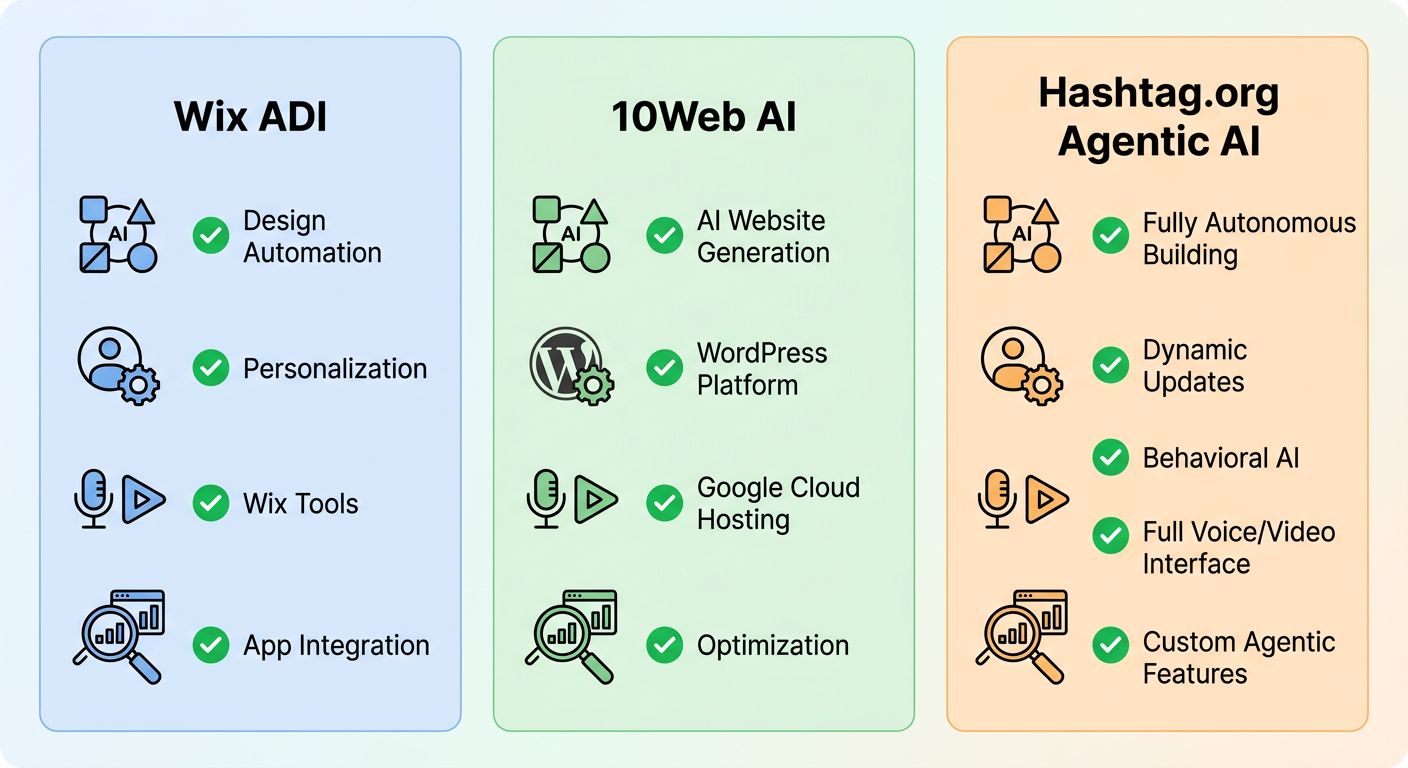
Now that we have explored web design trends 2026 in depth, it is time to turn insight into action. Implementing these trends effectively requires choosing the right tools, following proven integration practices, and measuring what matters. The comparison table below outlines three common approaches to help you evaluate which path fits your goals and resources. All figures are approximate and subject to change.
| Feature | Wix ADI | 10Web AI | Hashtag.org Agentic AI |
|---|---|---|---|
| Design Automation | Basic layout generation from questionnaire | WordPress site builder with AI content | Full geo-pinned portal with agentic AI |
| Personalization | Limited to initial setup | AI content personalization for blogs | Real-time persona-cloned agents |
| Voice & Video | No direct integration | No direct integration | Built-in live sessions (DREAM) |
| SEO & Visibility | Standard SEO tools | SEO optimization plugins | Agentic SEO (BRON) |
| Monetization | E-commerce integrations | E-commerce via WooCommerce | Stripe & USDC, marketplace |
Each approach serves different needs. DIY builders offer affordability and speed for straightforward websites, while custom development provides unrestricted creative control for complex requirements. Our AI agent platform combines rapid deployment with advanced AI capabilities.
Evaluating Tools and Platforms for Your Business
Choosing the right approach starts with an honest assessment of your resources and objectives. For limited budgets or urgent timelines, AI agent platforms like Hashtag.org offer a compelling balance of speed and functionality. You can claim your #name, train your agent, and deploy a web presence within days rather than months.
Speed should not come at the expense of compliance. When using AI-driven marketing platforms, review applicable advertising regulations in your target markets. The UK Advertising Standards Authority (ASA) provides clear guidance on misleading claims and digital marketing practices relevant to AI-generated content. We recommend understanding these standards before launching any AI-powered campaign.
Best Practices for Integrating AI, 3D, and Minimalism
Combining trends successfully requires a disciplined approach. AI-powered web design enables dynamic personalization that adapts content to user behavior and preferences. When tailoring content with AI, ensure compliance with local advertising regulations, such as UK advertising standards. Review all AI-driven personalization to confirm it meets applicable rules and accurately represents your brand.
Minimalism provides the foundation that lets AI and 3D shine. Eliminate unnecessary interface elements, optimize images, and prioritize clean layouts. A streamlined design ensures personalized content and 3D features capture attention without overwhelming visitors. Remember that AI-generated content may be inaccurate or incomplete; review before relying or publishing, and never treat AI outputs as professional legal, financial, or medical advice.
Measuring Success: Performance and Conversion Optimization
After implementing new design trends, tracking the right metrics reveals whether your efforts are paying off. Monitor three core areas: page speed, engagement, and conversion rates. Tools like Google PageSpeed Insights provide actionable data on load times and Core Web Vitals, which directly affect both user experience and search visibility.
Web Design Trends for Small Businesses: Budget-Friendly Adoption in 2026
The top web design trends 2026 offer budget-friendly paths that help small businesses enhance their online presence and customer engagement. For small businesses in Panama and across the globe, adopting these trends doesn't have to break the bank. According to the national advertisers association, AI is rapidly becoming a cornerstone of modern marketing, making AI Chatbots & Agents one of the most accessible and transformative trends.
| Factor | DIY Builder (Wix, Squarespace) | AI Agent Platform (Hashtag.org) | Full Custom Development |
|---|---|---|---|
| Cost | Low monthly fee ($12-50) | Tiered from $19-99 per month | High upfront ($5k-50k+) |
| Time to Launch | 1-2 weeks | 1-3 days | 2-6 months |
| Customization | Limited to templates | High (persona training) | Unlimited |
| AI Integration | Limited assistants | Full agentic AI package | Custom integration possible |
Frequently Asked Questions About Web Design Trends 2026
What are the top web design trends 2026?
The leading web design trends for 2026 include AI-powered automation, immersive 3D experiences, and agentic AI that works on your behalf — helping brands connect and convert.
How does AI-powered web design work?
AI-powered web design tools generate layouts, content, and personalization automatically. (Note: AI output can be inaccurate or incomplete — review before publishing; not professional advice.)
Embrace the Future: Harnessing Web Design Trends for 2026
The digital frontier moves fast, and staying ahead in web design trends for 2026 means embracing bold shifts. We believe the future belongs to sites that feel alive, adaptive, and distinctly yours.
Resources
- Explore the Evolution of the # Symbol in Computing
- Trace the Hashtag from Roman Origins to Twitter
- Uncover the Ancient Origins of the # Symbol
- Discover How Agentic AI Automates Marketing and SEO
- Review the Accessibility Statement for WCAG 2.1 AA
- Discover the History and AI Tools on Hashtag.org
- Discover the Spatial AI Naming Layer for Local SMBs
- Explore How the ASA Regulates UK Advertising Standards
- Discover the Association of National Advertisers (ANA)