Table of Contents
Deploying Autonomous AI Agents for Ecommerce Success
Building on autonomous AI agents, ecommerce brands deploy autonomous AI agents for ecommerce to automate real-time support, personalized recommendations, and lead capture. Agentic SEO for ecommerce boosts product visibility in AI-driven search, helping you reach shoppers in their local market.
Deployment is low-code. These autonomous AI agents for ecommerce run 24/7, handling queries and guiding purchases. You clone your brand voice via Nexus, set up conversational commerce autonomous agents for transactions and upsells, and launch from a geo-pinned portal. Our ai agent development resources walk you through stacking voice, video, and text agents without code.
- Claim your #name and pin your portal.
- Train your agent’s persona using Nexus.
- Activate agentic SEO and commerce features.
We host all agent services—voice, video, and live escalation—so you turn visibility into measurable interactions. Services are provided “as is” and outcomes vary.
Essential Setup Steps Before Deploying Your AI Agent
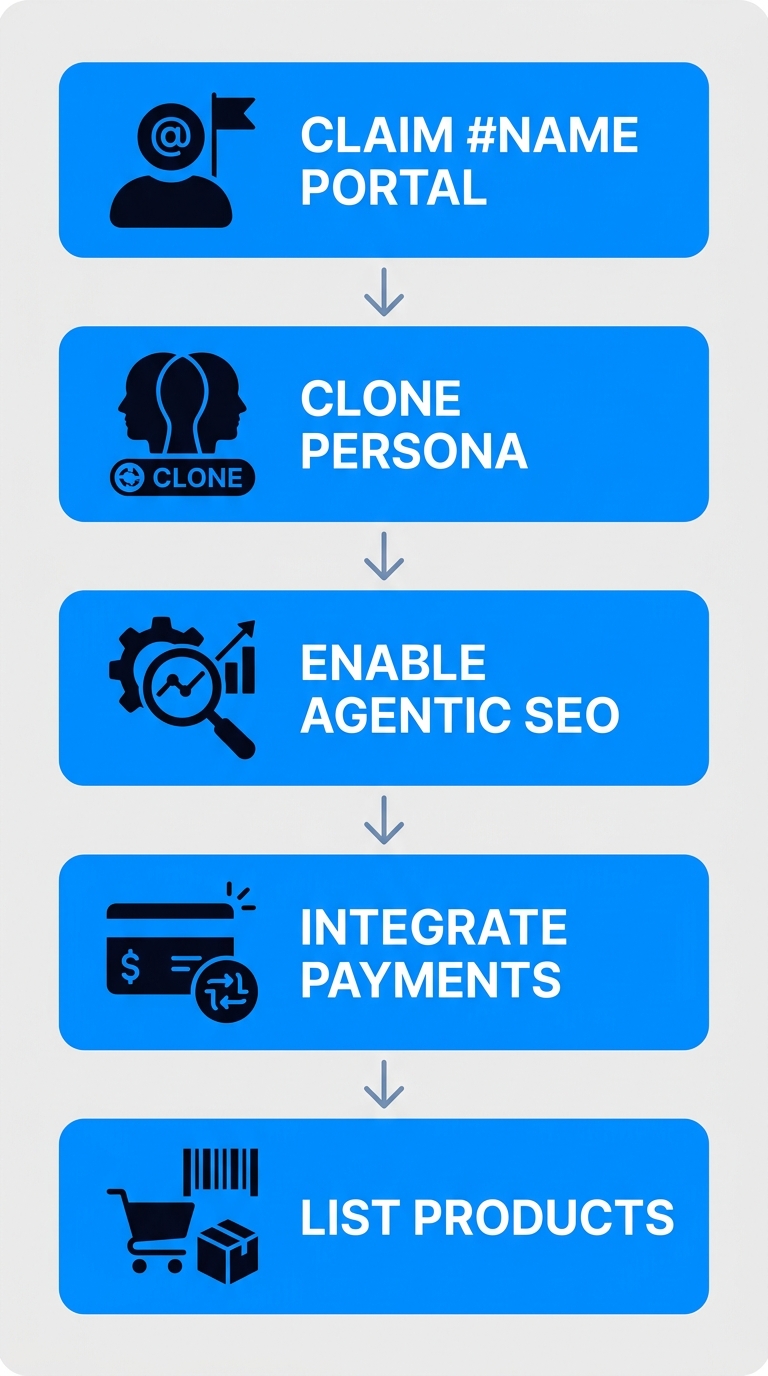
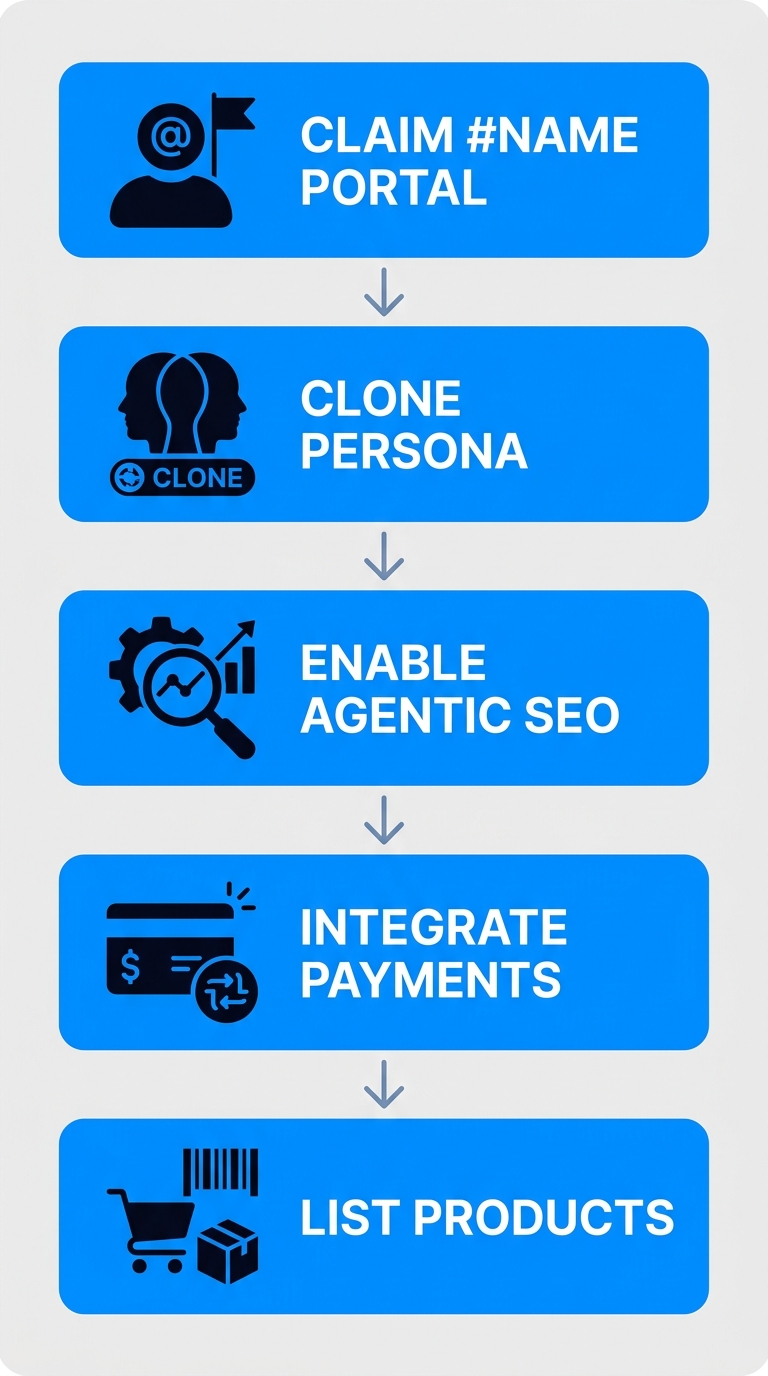
Deploying autonomous ai agents for ecommerce on hashtag.org unlocks round-the-clock engagement and sales, but a successful launch depends on careful pre-deployment configuration. We recommend completing these five essential steps to ensure your agent handles customer conversations, processes payments, and reflects your brand identity with precision.
First, claim your #name portal and configure geo-pinning to target your eCommerce audience (for example, 'in Baltimore for local deliveries'). Next, create your AI agent persona using your own voice and video recordings. This step, combined with geo-pinning, sets up your autonomous ai agents for ecommerce to engage customers authentically and locally. Our platform's Agentic AI tools, including GIGI, clone your vocal profile and mannerisms so that the agent sounds and looks like you, establishing authentic audience trust.
 Five essential steps to deploy your AI agent.
Next, enable Agentic SEO for ecommerce visibility. Our GEO FAQ explains how this differs from traditional SEO, but in short, configuring your agent for Agentic SEO ensures it appears in AI-powered search results like ChatGPT and Google SGE. Follow our SEO AI agent guide to activate these settings. Then, integrate Stripe or USDC payments to enable conversational commerce autonomous agents that can complete transactions instantly. Finally, list your products on the hashtag.org marketplace to give your agent a catalog for customer interactions.
After completing these setup steps, your AI agent is ready to launch. In the next section, we'll cover how to test and optimize its performance.
Claim Your #name on the Global Map
Your #name portal on the global map is the gateway for discovery in autonomous ai agents for ecommerce. Follow these steps to claim your #name portal now.
Instructions
Follow these steps to claim your #name portal now: choose a unique #name, verify ownership via email or social login, confirm your geo-pin on the global map. With your portal claimed, conversational commerce autonomous agents can discover your brand, and your geo-pinned portal appears on the map instantly.
Why It Matters
Claiming your #name portal is the foundational step for AI-driven discovery and monetization. It follows digital advertising industry standards for transparency and activates your visibility in agentic seo for ecommerce. Your channel. Your name. Your rules.
Tips
We recommend selecting a memorable, unique #name. Keep it short and brand-relevant, avoid generic terms already taken, and align it with your ecommerce store or niche. Once claimed, your #name appears on the public map, making you discoverable without active advertising.
After claiming your portal, you can customize your AI agent setup and explore the marketplace to start monetizing your presence.
Train Your AI Agent with Your Brand Voice
Leveraging our Agentic AI, personalized autonomous ai agents for ecommerce in your online store are only as powerful as the brand voice they emulate.
Instructions
To train your GIGI or SEVEN agent in your ecommerce store, follow these steps:
- Upload brand materials — logos, tone guidelines, and product descriptions — into the Nexus panel.
- Set persona parameters such as formality, vocabulary, and empathy tone.
- Provide curated example responses, then review and refine the agent’s outputs.
- Monitor conversation logs and adjust settings monthly; refer to our internal AI clone FAQ.
Why It Matters
A persona-cloned agent that speaks in your brand voice builds instant trust, critical for ecommerce conversions. Our agentic seo for ecommerce ensures that voice is consistent across all discovery touchpoints. This authentic presence lowers bounce rates and can lift purchase intent.
Tips
Start with curated FAQs to give your agent a strong conversational base. Review logs monthly and adjust persona parameters via the Nexus panel. For conversational commerce autonomous agents, iterative refinement improves trust and conversion. Always review AI-generated responses before publishing.
Enable Agentic SEO for Discoverability
Instructions
Building on that foundation, autonomous ai agents for ecommerce require Agentic SEO. We activate the BRON engine - Hashtag.org’s 22-year-old SEO core - to produce geo-optimized content for your ecommerce portal in Panama, targeting both traditional search and AI-driven discovery. Claim your #name portal, configure it for autonomous commerce queries; product pages then appear in AI overviews. For complete activation, see our official SEO AI Agent guide.
Why It Matters
Agentic SEO for ecommerce helps your portal appear in AI-generated overviews from Google SGE, Bing Chat, and ChatGPT, in addition to organic search. This dual visibility turns AI answer engines into new customer acquisition channels without relying solely on traditional keyword rankings.
Tips
Target conversational commerce autonomous agents as natural language queries. Update your geo-optimized content regularly and use geo-pinned #name portals for local relevance. Service provided “as is”; content may be inaccurate - review before relying. Then proceed to monitoring visibility.
Integrate Payments for Direct Payouts
Now that your portal is equipped with agents and SEO, the next critical piece is direct payout integration.
Instructions
With autonomous AI agents for ecommerce processing transactions, follow these steps to connect Stripe (fiat) and USDC (crypto) rails directly within your portal dashboard:
- Open your portal’s payment settings and select the Stripe integration option.
- Authorize your existing Stripe account or create a new one to handle card payments.
- Enter your USDC wallet address in the cryptocurrency rail field for peer-to-peer settlements.
- Save the configuration — both rails activate instantly, enabling you to receive revenue from agent-driven sales without third-party delays.
Why It Matters
We designed integrated payments to remove marketplace friction by processing transactions directly. With agentic SEO for ecommerce driving qualified buyers, your #portal on the map captures revenue instantly. As Hashtag.org’s DFY Catering Marketing System FAQ confirms, Stripe and USDC payout rails are built-in.
Tips
We recommend configuring payment flows for one-time purchases to process immediately upon checkout, with no recurring charges. For subscription-based services, enable auto-renewal billing so conversational commerce autonomous agents can manage ongoing member access. With payments live, your portal is ready to transact — we’ll fine-tune your agentic SEO next.
Deploy Conversational Commerce on Your Store
Now that we've covered what autonomous AI agents can do, let's deploy one on your store. Our conversational commerce solution integrates via a JavaScript snippet or REST API and powers live chat and voice sessions on Shopify and WooCommerce.
Instructions
Copy our JavaScript snippet and paste it into your theme header before the closing tag. The snippet renders a floating chat widget that connects your store to our discovery engine, laying the groundwork for agentic seo for ecommerce. For advanced integrations, use our REST API to embed the agent and connect to your checkout. The agent auto-imports your product catalog and answers in your brand's voice. Follow IAB digital advertising best practices for consent and privacy.
Why It Matters
Conversational commerce reduces support costs by resolving common questions instantly. It increases average order value through real-time product recommendations. These autonomous AI agents for ecommerce offer both text and voice interactions, creating an omnichannel experience that builds loyalty.
Tips
Customize the greeting script to reflect your brand. Set escalation rules for complex product queries. Review AI-generated content before publishing. Test different tones to make your conversational commerce autonomous agents feel natural.
Once your agent is live, the next step is to optimize it for discovery using our Agentic GEO tools, which we'll explore next.
Manage Inventory and Campaigns with AI
Instructions
Autonomous AI agents for ecommerce on your #portal let you set triggers that marry inventory signals with marketing workflows.
- When stock dips below the reorder point, the agent notifies your manager, drafts a purchase order, and uses agentic SEO for ecommerce to update schema and meta descriptions with low-stock signals.
- For conversational commerce autonomous agents, trigger a personalized discount offer through live chat when inventory dips, turning scarcity into immediate conversion.
- When seasonal stock reaches zero, the agent automatically pauses paid promotions and adds a restock-alert signup.
- We recommend timing low-stock alerts based on ANA best practices to maximize customer engagement. These triggers ensure inventory management and marketing actions never operate in silos.
Why It Matters
Our Agentic AI platform lets autonomous AI agents for ecommerce cut latency from hours to seconds, eliminating silos and manual handoffs.
Tips
Connect the agent to read-only ERP/CRM data via standard REST or GraphQL APIs—we support these integrations out of the box.
Beyond inventory and campaigns, the same agent can handle customer support, dynamic pricing, and more.
AI-generated content may be inaccurate, incomplete, or outdated — review before relying or publishing.
Track Revenue Attribution from AI Transactions
After deploying autonomous ai agents for ecommerce to drive transactions, we now need to track and attribute the resulting revenue. This section covers how to configure your #portal so every sale is tagged back to the AI agent interaction that originated it.
Instructions
Revenue attribution links each transaction to a specific AI agent interaction through a unique identifier such as a session ID or UTM parameter. To set up tracking:
- Use your portal’s built-in analytics to capture the originating agent and channel automatically.
- If linking to external checkouts, append UTM tokens to agent-generated links so the source is preserved.
- Verify that attribution logic persists whether the transaction occurs on your portal, marketplace, or an external site.
With these steps, you gain a clear line from conversation to conversion.
Why It Matters
Accurate attribution lets you calculate ROI per agent and compare performance across agents, enabling you to optimize agentic seo for ecommerce investment with confidence. Data-driven insights replace guesswork, so you can allocate budget where it drives the most revenue.
Tips
Connect attribution data to Google Analytics by sending custom events or goal completions from conversational commerce autonomous agents. Build a unified dashboard that surfaces performance shifts early, then review regularly to adjust your Agentic SEO strategy. While attribution data provides visibility for smarter decisions, it offers no guarantees of specific outcomes.
In the next section, we discuss how to use this attribution data to refine campaign spend and maximize agent performance.
Resolving Common Deployment Hurdles
Deploying autonomous AI agents for ecommerce unlocks game-changing capabilities—from 24/7 customer engagement to intelligent product recommendations—but the path from idea to live deployment is rarely smooth. We’ve found that integration snags, data privacy concerns, and adoption resistance are the most common hurdles teams encounter, all of which our platform is engineered to address.
Integration with existing ecommerce platforms like Shopify and WooCommerce often becomes the first stumbling block. Our pre-built connectors eliminate the need for custom code, letting you launch your AI agent quickly without straining development resources. Security is equally critical; our infrastructure is designed to meet PCI compliance and GDPR data-protection requirements and aligns with Interactive Advertising Bureau (IAB) industry standards for advertising data privacy, so customer information stays safe while your agent operates at scale.
Accuracy is another key concern—no one wants a chatbot hallucinating incorrect product details or pricing. Our persona-cloned AI agents are trained on your specific catalog and brand voice, reducing inaccuracies and scaling instantly to handle thousands of concurrent conversations during peak traffic. User adoption improves with our conversational commerce autonomous agents that feature voice and video mirroring your brand’s tone, helping customers feel like they’re talking to you, not a machine.
Traditional SEO relies on constant manual effort, but agentic SEO for ecommerce automates discovery across AI-driven search, ensuring your #portal surfaces when generative engines synthesize answers. With these deployment hurdles behind you, you can shift focus to growth through our done for you lead generation model. Actual outcomes depend on your setup and market conditions, but the foundation you’ve built positions you to convert AI-driven visibility into real revenue.
Next Steps for Ongoing Success with AI Agents
Once your autonomous ai agents for ecommerce are live, ongoing management ensures they remain effective and aligned with evolving business goals. We recommend three practical next steps.
- Schedule regular performance audits. Review agent interaction logs and conversion paths to pinpoint drop-off points and refine response logic.
- Update the agent’s knowledge base monthly with fresh product data, seasonal promotions, and updated FAQs to keep it relevant.
- Integrate analytics to track conversion metrics, then adjust agent prompts based on trends. As recommended by the Association of National Advertisers, use a balanced scorecard of engagement and conversion metrics.
To enhance discoverability, adopt agentic seo for ecommerce practices so your agent appears in AI-powered search results. Fine-tune conversational commerce autonomous agents through A/B testing of dialogue flows and feedback loops, aiming to lift repeat purchases. Iterative optimization—powered by customer segmentation and seasonal alignment—keeps your agent at peak performance.
Following established marketing industry best practices can help you refine your ongoing strategy for sustainable ecommerce growth.