
Table of Contents
Taking Control of Your Brand Citations in the Age of AI Search
Effective LLM citation management starts with a clear definition: a brand citation in AI search is any mention of your brand name accompanied by a source link or attribution in an LLM-generated response. Without proactive control, AI models may misrepresent or overlook your brand entirely. That's why we encourage businesses to move past passive optimization and actively manage how AI agents cite their digital presence.
A central measure of Generative Engine Optimization is your citation rate—the percentage of AI responses that mention your brand. Answer engine optimization also demands that those citations are accurate and contextually meaningful. According to Hashtag.org's FAQ, a strong citation rate reflects your authority relative to competitors, not a fixed number. By claiming a geo-pinned #name portal, an owner-verified digital hub, you give AI models a reliable reference to cite.
Our AI digital marketing platform blends your #name portal with Agentic SEO, letting you shape how large language models cite your brand. We provide these tools as-is without warranties; outcomes vary. Always review AI-generated content. Claim your #name to take control.
Essential Prerequisites for LLM Citation Management
Before we can take control of how our content appears in AI-generated answers, however, we must ensure a few critical prerequisites are in place on the hashtag.org platform. Solid llm citation management starts with establishing your verified identity and training your AI presence, so large language models consistently attribute your work correctly.
First, claim a personalized #name portal to create a verified identity anchor that LLMs can reference as the authoritative source. Next, complete the Nexus agent training so your AI persona generates consistent, on-brand responses that align with your cited content. Then activate our generative engine optimization settings to direct LLMs to your portal as the primary citation source instead of unverified third-party sites. You must also ensure your portal content includes clear author attribution and metadata—as demonstrated by Robert Bibb’s hashtag.org profile—to satisfy LLM citation requirements. Finally, to enhance answer engine optimization, we verify that your portal is geo-pinned and discoverable on the hashtag.org map so AI systems can locate it for location-specific queries.
Once these prerequisites are satisfied, we can move straight into configuring our citation monitoring dashboard. For a complete walkthrough of each step, consult our hashtag guide for creators.
Audit Your Current Brand Visibility in AI Search
Effective llm citation management starts with an honest measurement of where your brand stands in AI-generated results. Our experience shows that a simple manual audit provides the clearest initial snapshot.
Instructions
- Open ChatGPT, Perplexity, and Gemini in separate browser tabs.
- Search for your exact brand name, noting whether you appear as a linked source, an uncredited direct answer, or not at all.
- Repeat the process using 5–10 related queries, such as questions your ideal customer would ask.
- Record the total number of times your brand is cited across all engines to establish your baseline citation frequency.
Why This Step Matters
Without a clear baseline, generative engine optimization is guesswork. Measuring your current citation frequency reveals precisely where your answer engine optimization strategy stands, allowing you to set concrete, measurable improvement goals.
Pro Tips
- Use free tiers of tools like ChatGPT and Perplexity for manual searches, but remember a single query is never enough; sample multiple phrasings weekly. To increase discoverability, claim your name on an AI service directory platform.
- If your brand serves multiple locations, run location-specific queries to ensure your audit captures geographic variations in visibility.
- Treat this as a recurring habit. Tracking changes over time reveals whether your optimization efforts are genuinely impacting how often you appear in AI search citations.
Implement an llms.txt File to Guide AI Citations
Effective llm citation management starts with a simple file: llms.txt. For your brand, this is a foundational tactic in generative engine optimization, ensuring AI models reference the most relevant and up-to-date information from your portal. It’s a key move in answer engine optimization, giving you direct control over your AI citation strategy.
Instructions
Follow these steps to create and host your llms.txt file:
- Create a plain-text file named
llms.txt(all lowercase) and place it at the root of your domain (e.g.,https://yourdomain.com/llms.txt). - Ensure the file is served over HTTPS so LLM crawlers can always access it securely.
- Structure the file with three sections: an optional comment block (using
#) describing the file’s purpose, an[External]section listing top-level authority pages, and an[Internal]section for key resources. Use this syntax:
# Our brand's preferred citation sources
[External]
https://example.com/about
https://iccwbo.org/
[Internal]
https://example.com/portal-features
- Consider including external authoritative links like ICC trade resources to guide AI citations for trade-related queries.
Why This Step Matters
An llms.txt file gives your brand direct influence over the sources AI models surface, an essential part of llm citation management. According to our internal guidance on generative AI SEO, this reduces the risk of irrelevant or outdated citations, solidifying your authority in the Agentic AI landscape. It’s how you actively shape your brand’s narrative in an AI-driven world.
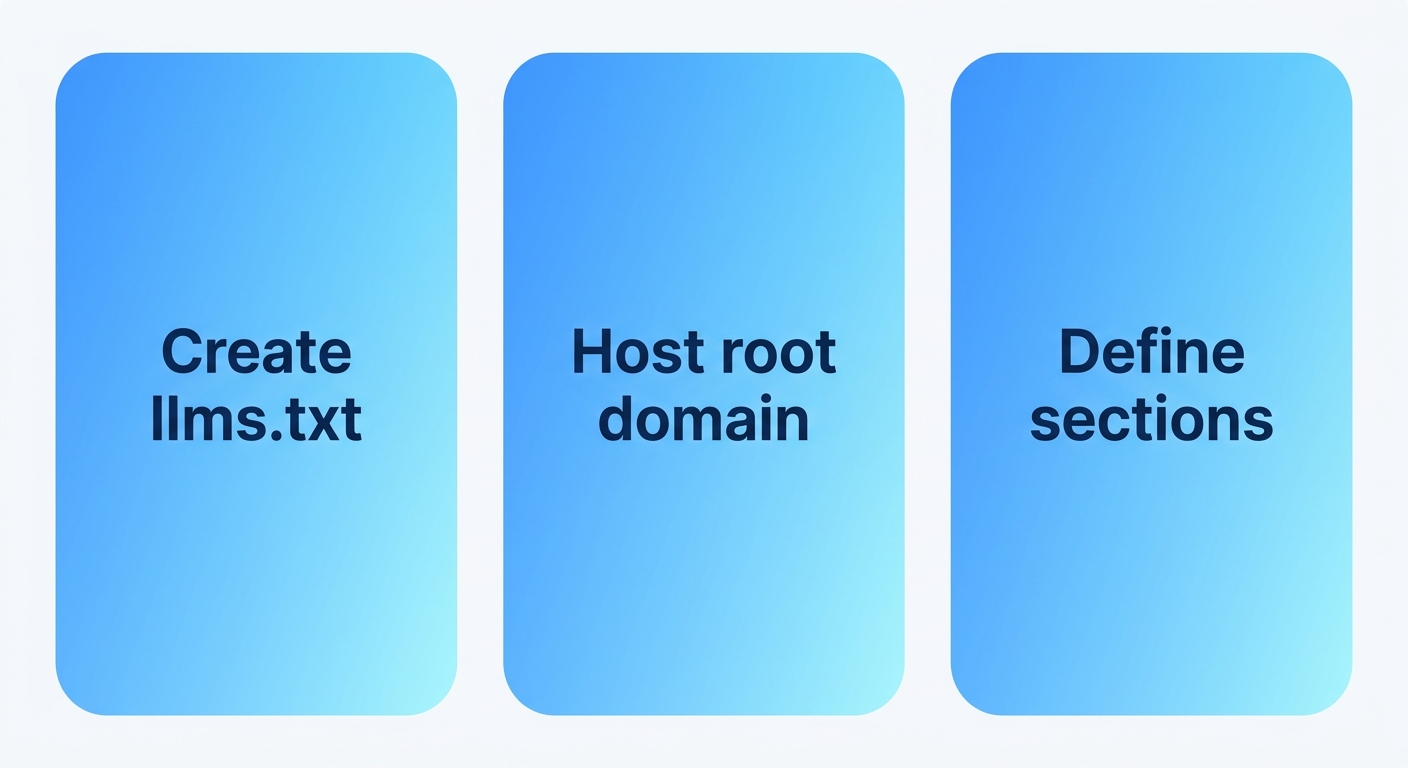
Three-step process to implement llms.txt for AI citations.
Pro Tips
To maintain effective AI source management, follow these best practices:
- Use a single
llms.txtfile for your entire domain, not one per subfolder. Consistency is key. - Update the file weekly or whenever major content changes occur on your portal to keep AI citations current.
- Never include URLs that are blocked by your
robots.txtfile; LLMs typically respect both directives.
Once your file is live, the next step is to track which sources AI models actually surface.
Structure Content for Generative Engine Optimization
Now that you recognize how GEO works, let's structure your content to maximise AI pickup. To excel in generative engine optimization, we recommend formatting every major concept as a direct question followed by a concise 2-3 sentence answer, mirroring how models like ChatGPT and Google SGE are trained to respond. Use bullet lists for features or steps and keep each bullet under 15 words to facilitate extraction. Explicitly name key entities such as "Google SGE," "Bing Chat," and “Hashtag.org's Agentic SEO” at least once per sub-section to anchor the content for AI models.
Instructions
We suggest this walkthrough for writing in formats preferred by GEI models:
- Phrase core ideas as direct questions with short answers.
- Use bullet lists for steps, keeping each under 15 words.
- Add FAQ structured data (Schema.org) to each Q&A block.
- Name key entities like “Google SGE" and "ChatGPT" explicitly.
- Keep answers under 50 words for answer engine optimization.
Why This Step Matters
Generative AI models favour content that directly answers user questions. Effective LLM citation management starts with structuring content for extraction, as each Q&A pair acts as a training data point for LLM citation systems. According to our internal AI SEO guidance, this approach increases the likelihood of being cited by generative engines and improves brand pickup in AI-generated answers.
Pro Tips
- Integrate structured data and internal links to Hashtag.org's Agentic SEO page.
- Use consistent entity signals across your digital ecosystem.
- When citing external sources for credibility, reference recognized frameworks such as IAB digital advertising standards to strengthen your content's authority with generative engines.
AI-generated content may be inaccurate or incomplete – review before publishing.
With your content structured for AI, the next step is to deploy automation that scales these formatting rules across your site.
Train AI Agents to Cite Your Brand Portal
Once your brand portal is live, the next critical step is training AI agents to cite it accurately. Nexus makes this straightforward.
Instructions
Follow these three steps to set up citation training:
- Upload brand assets (PDFs, URLs, guidelines) to Nexus, creating an authoritative knowledge base for your agent.
- Configure citation priorities—designate key pages as primary sources to support your answer engine optimization strategy.
- Test the agent with sample queries; verify it cites your portal before external sources and refine as needed.
Why This Step Matters
Effective LLM citation management ensures persona-cloned agents cite your brand first, boosting generative engine optimization. Trained agents keep your messaging consistent and reduce reliance on external interpretations. This directly supports your Agentic AI and Agentic SEO goals, strengthening your brand presence across LLM outputs.
Pro Tips
- Curate training data to include only current, high-value brand assets so agents avoid outdated citations.
- Mark your key portal pages as primary sources in Nexus.
- Enrich training with ANA marketing association resources; then test agent responses to catch citation drift.
Monitor Brand Mentions Across Large Language Models
Now that you've optimized your content for generative engine optimization, we recommend monitoring brand mentions across large language models. Effective llm citation management is how you confirm your answer engine optimization investments are paying off.
Instructions
To start monitoring:
- Set up automated alerts for your brand and product names across major LLMs including ChatGPT, Gemini, Claude, and Bing Copilot.
- Conduct weekly manual spot-checks with branded and unbranded keyword queries to capture direct, indirect, and competitor mentions that automated alerts might miss.
- Leverage hashtag.org’s AI Visibility Monitoring dashboard to centralize citation frequency tracking, share of voice comparisons, and model-specific performance in one place.
Why This Step Matters
Consistent monitoring is the feedback loop at the heart of any llm citation management strategy. It validates whether your optimization efforts are increasing citation rates and highlights areas needing adjustment. As our best practices guide notes, without regular tracking you lose the ability to measure what’s working.
Pro Tips
- Categorize every mention as direct (exact brand name), indirect (related topic or feature), or competitor to understand your AI visibility landscape.
- Schedule monthly audits with standardized reports that track citation trends, new model appearances, and changes over time.
- Treat citation rate as a relative performance metric, not a guaranteed outcome.
Apply Schema Markup for Answer Engine Optimization
Once your content is optimized for direct answers, applying structured schema tells LLMs exactly how to interpret that content. We implement four key schema types to maximize visibility in generative engine optimization and answer engine optimization results.
Instructions
First, deploy FAQ schema on pages answering common user queries. Ensure required properties like mainEntity, name, and acceptedAnswer are valid JSON-LD. Next, use HowTo schema for procedural content with step and text properties. For standard articles and blog posts, apply Article schema with headline, author, and datePublished. Use QAPage schema for dedicated question-and-answer pages, including suggestedAnswer where available. Always test markup with Google's Rich Results Test before publishing, checking for common errors like missing @context or invalid JSON-LD syntax.
Why This Step Matters
Structured markup directly supports llm citation management by increasing entity knowledge graph density. Our internal research indicates that properly marked-up content is parsed more accurately by LLMs, increasing citation frequency as the AI recognizes your content as a definitive, structured answer source within generative engine optimization frameworks.
Pro Tips
- Avoid over-marking content that isn't a clear answer, as LLMs penalize irrelevant schema in answer engine optimization workflows.
- Pair schema with conversational phrasing in each step to make extraction effortless, reinforcing your llm citation management strategy.
- Embed the target keyword naturally in Q&A blocks rather than forcing placement.
Overcoming Common Citation Obstacles and Gaps
Now that you understand the ideal citation framework, it’s time to tackle the real-world hurdles that block even well-crafted content from earning AI citations. Effective llm citation management starts with recognizing and closing those hidden gaps.
One common obstacle is low domain authority. Generative engine optimization depends on entity knowledge graph density, but newer or smaller sites lack the citation footprint that signals trust. We recommend building authority deliberately by earning mentions on reputable industry sites and maintaining consistent NAP data across directories, a practice that feeds the AI’s entity map.
Another frequent gap is missing or malfunctioning schema markup. Without structured data like Organization and Article schemas, even high-quality pages become invisible to retrieval pipelines. Our internal schema checklist confirms that implementing Schema.org markup and ensuring all pages use rel="canonical" to avoid fragmentation dramatically improves a domain’s chance of being cited.
A third hurdle is reliance on non-indexed or paywalled sources. LLMs cannot access gated databases, so content behind logins or paywalls is effectively uncitable. We also see citation gaps when multiple pages on the same topic contradict each other; LLMs skip both to avoid ambiguity. The fix is to create a single, public-facing authority page per topic, structured with clear headings and semantic HTML5, and perform a monthly citation audit using our visibility monitoring tools to catch and address gaps before they compound. Our internal FAQ benchmarks place a healthy citation rate at roughly five to ten mentions per topic area, though actual results depend on your niche and competitive landscape.
Overcoming these gaps transforms a site from intermittently cited to reliably referenced, a goal at the heart of answer engine optimization. Once you clear these common obstacles, you can layer in advanced strategies for maximum AI discoverability. Consistent llm citation management turns fragmented signals into a cohesive presence that generative engines reward.
Building a Sustainable LLM Citation Strategy for Your Brand
Building on that foundation, a sustainable strategy for llm citation management requires more than one-time optimization. We anchor our llm citation management strategy on three pillars powered by hashtag.org’s platform.
First, content authority through original, regularly updated material keeps your information fresh in LLM retrievals. Second, structured data via Schema.org markup strengthens your entity knowledge graph density, a key factor in generative engine optimization. Third, AI agent alignment with persona-cloned agents that answer in your brand’s voice ensures consistent, on-message citations across answer engine optimization surfaces. Our AI Visibility Monitoring tool provides real-time feedback on which LLMs cite you, while our best practices guide recommends quarterly citation density checks and content refresh adjustments. The platform’s transparent “as is” terms simply encourage brands to own their citation hygiene.
With this strategic framework in place, the next step is to configure your #name portal. Your channel. Your name. Your rules.