Table of Contents
- Autonomous AI Agents vs Chatbots: Understanding the Core Differences
- Core Concepts: AI Chatbots and Autonomous Agents
- Autonomous AI Agents: Capabilities, Decision-Making, and Multi-Step Task Execution
- Choosing Between AI Agents and Chatbots for Business Needs
- Advanced Considerations: Autonomous Decision Making and Future Trends
- Frequently Asked Questions About AI Agents and Chatbots
- Making the Right Choice for Your Marketing Strategy
Autonomous AI Agents vs Chatbots: Understanding the Core Differences
Comparing autonomous AI agents vs chatbots reveals a shift from reactive, scripted interactions to proactive, goal-oriented intelligence. Chatbots respond to user prompts based on predefined decision trees; autonomous AI agents independently reason through tasks, plan steps, and execute multi-stage objectives to achieve a desired outcome. We believe this distinction is reshaping how businesses and individuals leverage AI beyond simple Q&A.
From our experience, chatbots typically follow if-then logic or keyword matching, making them effective for structured dialogues like appointment scheduling or FAQs. Autonomous AI agents, however, combine large language models with planning modules, memory, and tool use to break complex goals into subtasks and adapt when conditions change. This enables them to handle workflows that require judgment and sequence, not just a single-turn response. Where a chatbot might stall when facing an unexpected input, an autonomous agent can re-evaluate its plan and call on external APIs to retrieve relevant data or adjust course.
An example of this in customer service: A chatbot can reset a password or tell a customer what the status of their order is. An autonomous AI agent can do that, as well as determine why the customer is having an issue, verify the customer’s account history, reach into shipping and inventory systems to organize and accomplish a resolution to the customer issue, and even follow up and send notifications to the customer once the shipping delivery has occurred. An autonomous agent can take a multi-turn, non-scripted approach to resolving complex issues.
Understanding these differences in technologies comes from analyzing the core architecture. Each technology makes use of intent detection, dialogue state management, and planning, but the level and type of integration of components can differentiate one technology from the other.
Key Takeaways
- AI chatbots are conversational software systems designed to accept user input and reply with appropriate, context-aware responses generally derived from a curated knowledge base or pre-trained language model.
- The transition from scripted responses to autonomous AI agents represents a significant advancement in how artificial intelligence is deployed in business.
- The focus during an evaluation of Autonomous AI Agents vs Chatbots shifts from capability to implementation.
- We provide answers to typical questions that clarify the distinction between AI agents and chatbots.
- After answering the most frequent questions, when considering autonomous AI agents vs chatbots for your marketing strategy, the choice ultimately comes down to your goals.
Core Concepts: AI Chatbots and Autonomous Agents
AI chatbots are conversational software systems designed to accept user input and reply with appropriate, context-aware responses generally derived from a curated knowledge base or pre-trained language model. Because their logic often depends on intent recognition and scripted dialogue flows, an AI chatbot operates with limited autonomy; it reacts to explicit prompts rather than independently assessing a situation and deciding what to do next. This makes chatbots highly effective for single-domain tasks like customer service triage or FAQ deflection, but it also means they struggle when asked to handle multi-step objectives that require tool use, cross-system reasoning.
Autonomous AI agents, in contrast, are systems engineered to pursue goals with minimal human intervention. An agent receives a high-level objective—for instance, qualifying inbound leads and scheduling consultations—and then breaks that aim into sub-tasks, selects the correct tools, evaluates outcomes, and adjusts its plan as conditions change. Unlike a chatbot that waits for a user to ask the next question, an autonomous agent maintains its own internal task representation and can shift between actions such as querying a CRM, sending an email, or updating a calendar without being prompted again. This capability introduces a fundamentally different operating model: chatbot systems are reactive, while agentic AI is proactive and goal-oriented, often orchestrating several services or data sources in parallel to fulfill a single request.
Where an AI chatbot functions best as an assistant tethered to a conversation, an autonomous AI agent operates as a participant in a workflow, capable of evaluating context, selecting strategies, and taking action across multiple domains. The distinction also surfaces in deployment scope: chatbots excel within a bounded conversation topic, whereas agents navigate diverse tools, APIs, and knowledge repositories to deliver results that span departments or systems. In practical terms, a retailer might deploy a chatbot on its website to field common order-status inquiries, while an autonomous agent monitors inventory thresholds, triggers purchase orders, and notifies the warehouse team—all without a human stepping in after the initial rule set is configured.
It is worth noting that the boundary between these two paradigms is growing less rigid. Modern chatbot architectures increasingly incorporate chain-of-thought reasoning, tool calling, and memory modules, effectively adopting agentic features that allow them to handle more open-ended requests. This convergence means that the discussion is less about rigid categories and more about a spectrum of autonomy—a continuum on which organizations can position their tools depending on the level of independence, risk tolerance, and task complexity their workflows demand.
Autonomous AI Agents: Capabilities, Decision-Making, and Multi-Step Task Execution
The transition from scripted responses to autonomous AI agents represents a significant advancement in how artificial intelligence is deployed in business. Whereas the rule-based bots are designed to follow prescriptive decision trees, the new-age AI agents are designed to take actions to accomplish goals, make decisions, and take actions based on context. Advancements in Natural Language Processing and Understanding (NLP, NLU) enable AI to decipher and classify context and draw relevant conclusions. This allows for real time goal setting and adaptation based on variable and ever changing external stimuli. At hashtag.org, our seven plus years experience in AI-driven marketing has provided us the opportunity to study and analyze how the employment of Autonomous AI Agents reshapes interactions and alters processes in businesses.
From Rule-Based Responses to Autonomous Execution
With the advent of autonomous AI agents, the ability to decompose goals into smaller, executable subgoals gave rise to the capability of agents to undertake multi-step processes, or goals.
Advances in natural language understanding gave these systems the ability to interpret intent rather than merely keywords. These systems make choices based on anticipated outcomes and impacts. A customer service AI agent, for example, would be able to determine, without a script, whether a given issue warranted a refund or replacement, or whether it should be escalated to a technical support case.
Multi-Step Task Execution Across Software Platforms
Autonomous AI Agents automate workflows by breaking up tasks across multiple apps using APIs and applying execution models to goals. For example, an AI Agent can take a customer service ticket, retrieve the order details in a CRM, verify the payment status to see if a refund is required, process a refund using Stripe, and send a confirmation email all in one autonomous sequence. The more steps it can perform in a single autonomous sequence, the faster it can resolve a ticket and the less manual intervention is required.
The following table gives a comparison of some features of AI chatbots and autonomous AI agents.
| Feature | AI Chatbots | Autonomous AI Agents |
|---|---|---|
| Autonomy Level | Operate within predefined rules and scripts | Make independent decisions and adapt to new contexts |
| Decision-Making Approach | Follow decision trees with limited branching | Use goal decomposition, planning, and real-time reasoning |
| Task Complexity | Handle single-step or simple multi-turn tasks | Execute complex, multi-step workflows across systems |
| Integration Capabilities | Limited to pre-integrated messaging platforms | Connect with CRMs, payment systems, email, and APIs |
| Learning Ability | Static responses unless manually updated | Learn from feedback and improve over time |
Most businesses can determine the right approach to automation based on the information in the table. Generally, chatbots are better suited to answer simple, repetitive questions, whereas, for more dynamic and cross-platform processes that require some degree of judgment, an Autonomous Agent can be used.
Transforming Customer Service with Autonomous Agents
Autonomous Agents enable a shift from reactive ticket management to proactive resolution. When a customer reaches out to support, the Agent can review recent orders, and retrieve the account history to provide a personalized response. It determines whether the issue can be resolved automatically or requires human escalation, routing complex cases to the right team with full context.
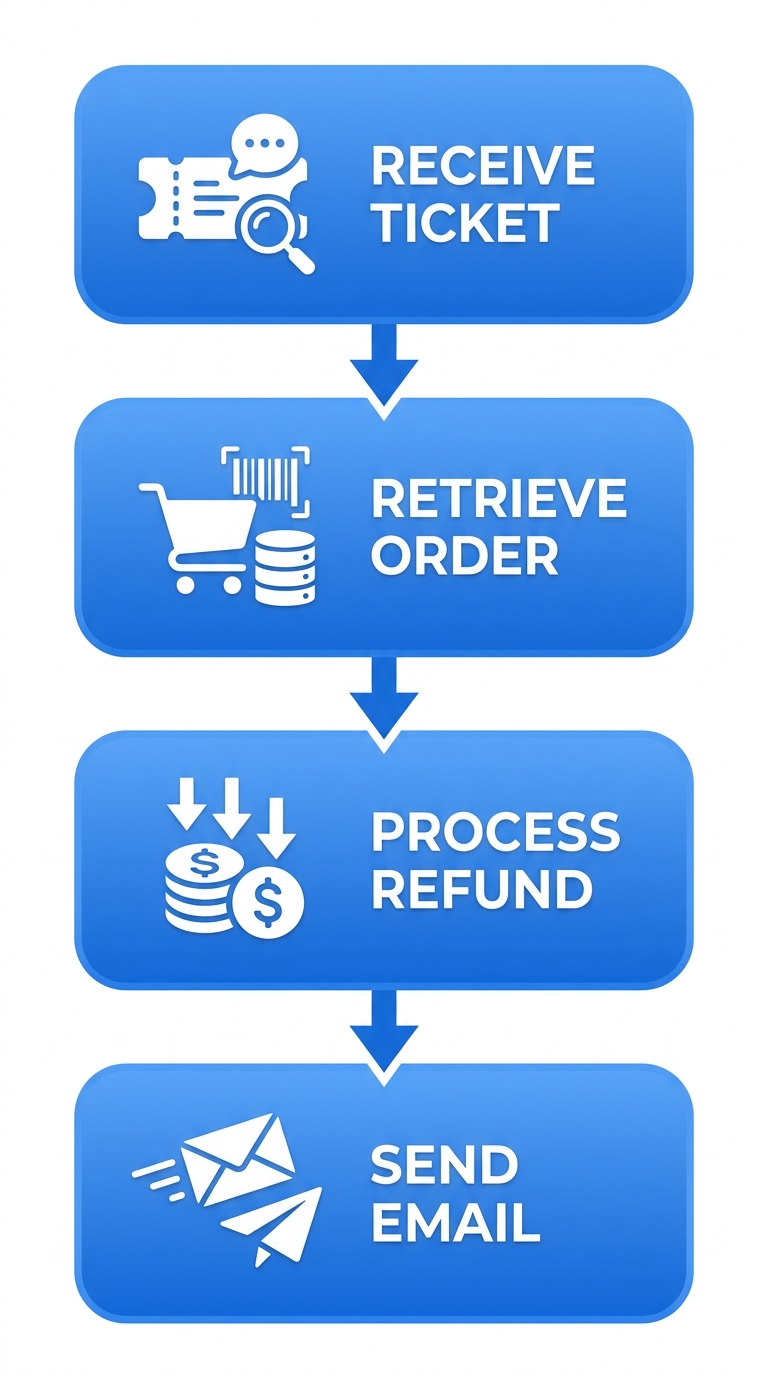
One example is when a customer states that a product they purchased is defective. The Agent can review the order record to verify the claim is within the return policy, process a refund through the payment system, and send a confirmation email with next steps—all within moments. The practical choice between deploying chatbots and autonomous agents comes down to the complexity of tasks a business needs to automate and the level of customer experience it aims to deliver.
Choosing Between AI Agents and Chatbots for Business Needs
The focus during an evaluation of Autonomous AI Agents vs Chatbots shifts from capability to implementation. Both AI and chatbots enable customer interactions. However, the level of autonomy and personalization, and the extent to which they can be integrated into existing systems differ significantly.
Defining Business Requirements for AI Agent Implementation
A clear implementation plan starts with mapping every customer touchpoint where automated conversation could add value. This is the first question that should be answered to devise an effective implementation plan. You may wish to automate customer conversations using chatbots for simple activities such as answering FAQs. Lead qualification, appointment booking, or personalized recommendations benefit from the reasoning and memory of an AI agent.
AI Agents can autonomously guide a prospect from initial question to a scheduled call while adapting their tone and follow-up logic, but that depth is wasted if your primary need is only to answer store hours.
Traditional chatbots follow pre-scripted flows and often fail when a visitor phrases a question unexpectedly. An AI agent, by contrast, interprets intent, maintains context across a conversation, and can even escalate to a human with full summary notes when needed. We at hashtag.org help businesses evaluate these factors so the chosen solution matches their interaction complexity, not just their current comfort level.
Comparing Costs: Maintaining AI Agents vs Traditional Chatbots
A basic chatbot may be operational in hours with minimal configuration, while a well-trained AI agent requires persona customization, knowledge ingestion, and testing to ensure reliable responses.
Chatbots are rigid, requiring frequent manual updates to scripts and decision trees whenever a change occurs to your offerings. Compared to chatbots, an artificial intelligence (AI) agent is able to learn the answers to new questions in a content update and refine its answers over time through monitoring and feedback. However, governance is still required—reviewing conversation logs, updating training data, and adjusting guardrails—to keep the agent on-brand and compliant.
While a chatbot that works well in a web channel may require a complete rewrite for use in other channels (e.g., voice, SMS, or social), AI agents designed for omnichannel deployment can often extend their existing knowledge to new touchpoints more gracefully. Each additional channel may, however, increase costs related to integration and testing.
When to Choose an AI Agent Over a RAG Chatbot
When answering questions, RAG chatbots excel at pulling information from a defined knowledge base. AI agents, on the other hand, are able to reason and take actions. They are also able to construct and update a user model over time.
If capturing a lead is the goal, an AI agent is able to take qualifying actions (e.g., engage in a conversation, remember and refer to prior questions and answers, and, upon qualifying the lead, alert the user and redirect the lead to the sales team) to support the user and achieve the objective of the conversation.
Complete with a consistent persona across chat, voice, and video, an AI agent that supports cloning and custom knowledge becomes the obvious choice when you want technology to speak for your brand. This is vital for creators, agencies, and businesses that win business based on their personality and trust.
An AI agent that is able to book and process payments and follow up via email based on context pulled from a CRM, outperforms an RAG chatbot that is constrained to a single channel and a question-answer format. We advise organizations to examine their interaction scenarios based on these criteria, avoid the lure of full autonomy when a simpler, more focused assistant would serve their audience just as well, and step up to an AI agent when the conversations require judgment, continuity, and genuine representation.
Advanced Considerations: Autonomous Decision Making and Future Trends
Once you’ve selected between an AI agent and a chatbot, you need to understand the difference in how they make decisions. Most chatbots are rule-based and linear, following paths determined during development and responding only to explicit triggers. AI agents, on the other hand, use learning-based, autonomous decision making, and can evaluate context, consider alternatives, and take action on their own.
| Approach | How It Decides | Typical Example |
|---|---|---|
| Rule-based logic | Follows if-then scripts and keyword triggers | Chatbot that replies with a help article when it sees "refund" |
| Retrieval-augmented LLM | Searches a knowledge base and synthesizes an answer | Chatbot that drafts a reply from uploaded documents |
| Fully autonomous agentic AI | Maintains state, makes goal-driven choices, and escalates when needed | AI agent that routes sales-ready leads to a human rep |
Chatbots can be useful for routinized activities, but are unhelpful when customers deviate from the expected. Retrieval-augmented systems can be flexible in their responses to some extent by accessing stored information, but still cannot make decisions on their own. Fully agentic AI can fill that gap by evaluating customer intent, determining next best actions, and potentially handing off the case to a human if needed.
Looking ahead, there are emerging, positive trends reshaping what autonomous AI agents can accomplish. We've observed increasing interest in multi-agent coordination, which allows specialized agents to collaborate on tasks that span sales, support, and scheduling and reduces manual handoffs between departments, and in human-in-the-loop models that preserve final approval for high-stakes actions while letting routine work proceed automatically. Many teams are seeking assistants that not only answer questions but anticipate needs, configure meetings, and follow through on multi-step workflows without constant prompting.
To address common questions about these technologies, the following FAQs clarify practical usage.
Frequently Asked Questions About AI Agents and Chatbots
We provide answers to typical questions that clarify the distinction between AI agents and chatbots.
What is the difference between an AI agent and a chatbot?
AI agents operate autonomously to complete tasks; chatbots follow scripted interactions.
Can AI agents replace human customer service?
They handle routine queries and augment human teams, but cannot replace the empathy needed for complex situations.
What are typical use cases for each?
Chatbots work well for FAQ support and simple lead capture, while AI agents excel at personalized recommendations, scheduling, and automated lead qualification.
How accurate are AI-generated responses, and should I verify them?
AI agents require training on your business content, and we recommend verifying outputs; they should not be used as professional advice without human review.
These answers help you evaluate where AI agents and chatbots fit your marketing stack.
Frequently Asked Questions
What is the difference between an ai agent and a traditional chatbot?
An AI agent independently reasons through tasks, plans steps, and executes multi-stage objectives, whereas a traditional chatbot responds based on predefined scripts or decision trees. Agents maintain context, use tools, and adapt to new conditions; chatbots are reactive and limited to single-turn or simple dialogues within a set topic.
When should a business choose an ai agent over a rag chatbot?
A business should choose an AI agent over a RAG chatbot when it needs to reason, take actions, and maintain a user model across channels, not just retrieve information. AI agents qualify leads, book payments, and follow up with context from a CRM while maintaining a consistent persona, tasks a question-answer RAG chatbot cannot perform.
Can ai agents execute multi-step tasks across different software?
Yes, AI agents execute multi-step tasks across different software by decomposing goals into sub-tasks and using APIs to connect CRMs, payment systems, email, and other platforms. They can retrieve order details, verify payments, process refunds through Stripe, and send confirmations in one autonomous sequence without manual steps.
Are ai agents more expensive to maintain than chatbots?
Yes, AI agents typically cost more to maintain than chatbots due to persona customization, knowledge ingestion, testing, and ongoing governance such as reviewing logs and updating guardrails. Chatbots are simpler but need frequent manual script updates; agents learn from content updates over time, though each added channel may raise costs.
How do autonomous agents handle customer service differently?
Autonomous agents handle customer service proactively by reviewing order history, verifying claims, and resolving issues autonomously, rather than merely reacting to prompts. They determine if a refund or escalation is needed, process actions through payment systems, and route complex cases to human teams with full context for personalized resolution.
Making the Right Choice for Your Marketing Strategy
After answering the most frequent questions, when considering autonomous AI agents vs chatbots for your marketing strategy, the choice ultimately comes down to your goals. For a consistent brand voice, face and geo-pinned discoverability, GIGI delivers what chatbots cannot. Traditional chatbots remain practical for high-volume and simple queries. For more representation, agentic AI is the way to go.
Service is 'as is' with no warranties; AI-generated content may be inaccurate; we provide no professional advice or guaranteed outcomes; crypto features carry risk and are not investment advice.
Start Your AI Agent Journey
Now that you understand the fundamental distinctions between chatbots and autonomous AI agents, you're in a position to act on your marketing objectives. The guide has walked you through decision-making frameworks, cost considerations, and practical use cases for agentic AI. An agent like GIGI can represent your brand with a consistent voice, visual persona, and geo-pinned discoverability that static chatbots simply cannot match. From multi-step task execution across software platforms to autonomous lead capture, the capabilities are transformative. Getting started with your own AI agent is straightforward on our platform. We can help you claim a geo-portal, configure voice cloning, and train a persona that reflects your brand's unique tone. Explore the next step toward an autonomous, always-on business presence.