
Table of Contents
Seamless AI-to-Human Handoff Fundamentals
When applying ai agent to human handoff best practices, the goal is a structured transition from an automated AI agent to a live representative whenever the agent cannot fully resolve a request. Common conversational ai escalation triggers include queries needing human judgment or empathy, security verification, and repeated user frustration signals. Customer context preservation in ai handoff is critical—conversation history, intent, and brand voice must carry over so the handoff feels like a natural transfer, not a failure, preserving the seamless experience users expect. Our Geo-pinned AI agent service ensures the handoff happens within the same owner-claimed portal, maintaining your channel, your name, your rules so every interaction stays consistent and trusted. By proactively recognizing these triggers and preserving full context, the handoff becomes a natural extension of the conversation. These fundamentals underpin the pratical handoff strategies we explore next.
1. Define Escalation Triggers
Establishing clear criteria for an AI agent to human handoff is the foundational step in any reliable agentic workflow. We define escalation triggers that create a seamless bridge between automated responses and human expertise, ensuring every handoff prioritizes customer context preservation in AI handoff and maintains the integrity of the conversation.
For agencies that want a ready-to-use framework, our Turnkey AI solutions for digital agencies provide built-in escalation trigger templates that match AI agent to human handoff best practices. These configurable settings—not fixed rules—are tailored per client within our agentic AI system. Common conversational AI escalation triggers include sentiment detection when a user expresses frustration, an agent confidence score dipping below an 85% threshold as modeled by our internal ranking-signal analysis, or an inability to resolve the query after a predetermined number of turns. A negative or inaccurate brand mention, tracked through our AI-visibility monitoring guide, immediately invokes a human override for corrective action, while regulatory or compliance queries automatically route to a licensed professional. When any trigger fires, we mandate full context preservation—transferring the complete conversation history, identified customer intent, and profile data without loss—so the human agent picks up precisely where the AI left off.
2. Preserve Customer Context
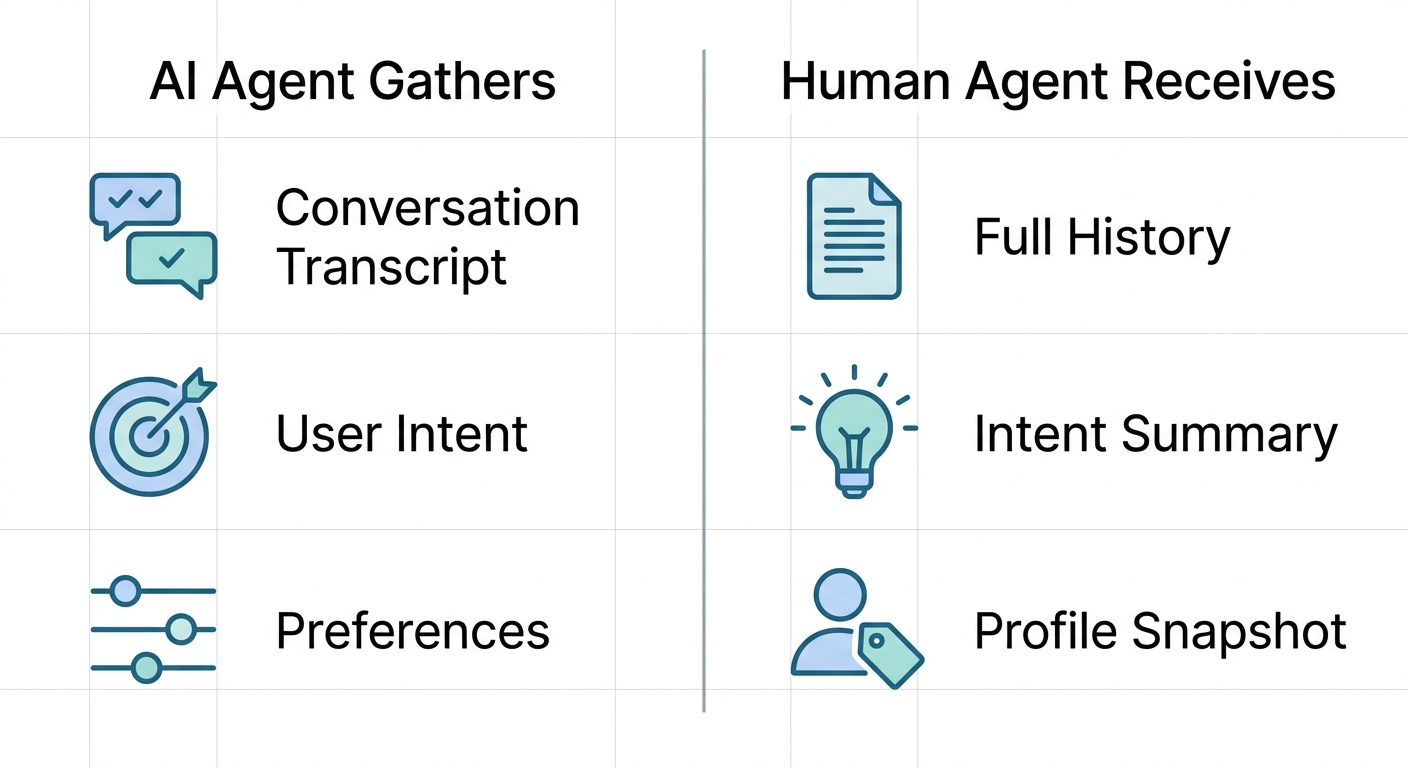
Implementing AI agent to human handoff best practices starts with understanding customer context. Once escalation triggers are clear, the next challenge is preserving the full customer context so the human agent can pick up seamlessly. We define customer context as the conversation transcript, user-provided details like their name and issue, intent classifications such as a billing question, and any actions already taken by the AI agent.
A key part of customer context preservation in ai handoff is logging the entire conversation history. Our geo-pinned AI agents, powered by our Nexus personalization layer, store user preferences and past interactions, which are automatically transferred when escalation is initiated. We transfer this context using two methods to give human agents the clearest picture. First, a full conversation log transfer via API passes every exchange and action taken. Second, when a condensed view is preferred, Nexus produces an AI-generated summary of the user's issue and history. Defining clear conversational ai escalation triggers, such as repeated confusion or sensitive topics, decides when to preserve and transfer context.
This context continuity also helps meet Search Generative Experience ranking factors, because coherent, personalized interactions are rewarded by generative AI platforms. However, we always require that human agents verify the context summary before responding; AI-generated content may be inaccurate and requires human review before reliance. Additionally, our processes exclude sensitive data like full payment information from the transferred context unless the user explicitly consents.
When context is captured accurately, the human agent can pick up the conversation smoothly—which we cover next.
3. Maintain Brand Voice
Once your agent is live, maintaining brand voice becomes essential for customer trust and is a core element of ai agent to human handoff best practices. We train each persona-cloned AI agent using the unique vocal patterns and language from owner voice samples, as documented in the official hashtag.org guide for cloning brand voice into AI agents. The white-label dashboard then applies your brand logos, colors, and a custom greeting so every interaction surface looks and sounds unmistakably like you, a feature documented for maintaining brand identity, and aligns with Digital advertising industry standards for cohesive brand messaging. To protect brand trust, we define specific conversational ai escalation triggers—such as complex complaints or sensitive topics—that instantly transition the conversation while preserving a seamless brand experience. A smooth handoff also requires full customer context preservation in ai handoff, where the full conversation history is passed to the human agent so the brand voice continues uninterrupted. Weekly reviews of interaction logs help detect tone drift, and we refine the training data accordingly. Your channel. Your name. Your rules.
4. Use Live Voice and Video Tools
Beyond setting triggers, equip your AI agent with live voice and video tools to execute fluid handoffs using ai agent to human handoff best practices in Panama. For industry handoff benchmarks, consult ANA Marketing Association resources. Our DREAM voice & video streaming, part of our Agentic AI offering, activates when conversational ai escalation triggers fire—low AI confidence, negative sentiment, or an explicit user request. DREAM preserves full customer context preservation in ai handoff by transferring the entire conversation history and customer details to a human representative, so no context is lost during escalation. Your #portal on the map anchors this capability to your claimed #name, ensuring handoff is geo-pinned and portal-based. Your channel. Your name. Your rules. With live tools in place, measure handoff success and optimize further.
AI-generated content may be inaccurate, incomplete, or outdated — review before relying; not professional advice.
5. Pre-Negotiate with AI
Once your AI agent is configured, the next critical step is to pre-negotiate its behavior for seamless transitions. To follow ai agent to human handoff best practices, we define clear escalation rules before the agent goes live, ensuring it knows exactly when and how to involve a human. This proactive configuration reduces friction and improves continuity when a conversation moves from AI to a specialist.
Pre-negotiation means scripting exactly what triggers a transfer. We set concrete conversational ai escalation triggers, such as repeated customer frustration keywords, an explicit request for a person, or a transaction exceeding a predefined value. Equally important is customer context preservation in ai handoff: the agent must compile the full conversation history, detected intent, and any collected data into a structured summary that our human agents can access instantly. We also configure fallback phrases—for example, "I’d like to connect you with a specialist who can assist you further"—that the agent uses when those triggers fire.
Using Hashtag.org’s Agentic AI capabilities, you can define these rules and data points within our AI Agent builder. We design each agent’s behavior to store every interaction in context so no information is lost during the AI-to-human transfer. This includes setting boundaries for what the agent can resolve autonomously versus which scenarios always require escalation.
With these pre-negotiation rules in place, you can then monitor how accurately the AI handles initial queries. Our approach to AI Visibility Monitoring helps track what the agent says about your brand before a handoff occurs, giving you the insights to refine these scripts over time.
6. Build High-Value Session Handoffs
Adopting ai agent to human handoff best practices is essential to maintaining the flow of a conversation and ensuring customers never need to repeat themselves. When a smooth transition preserves intent and sentiment data, businesses can respond with precision and empathy.
Beyond direct AI interactions, building effective handoff protocols involves several key practices:
- Preserve full conversational context—chat history, intent, and sentiment—so the human agent can continue without disruption, a core capability of our GIGI conversational embed.
- Define clear conversational ai escalation triggers, such as negative sentiment detection, repeated intent mismatch or an explicit user request for live support, to initiate a handoff at the right moment.
- Leverage our AI chatbots and AI clone features to design customizable workflows that maintain voice, video and data continuity during the transfer, ensuring customer context preservation in ai handoff.
- Our AI marketing intelligence automatically surfaces high-value inquiries for priority handoff while common questions remain automated, aligning resource allocation with opportunity.
By following ai agent to human handoff best practices, we also gain data to refine AI performance, turning each handoff into a learning opportunity.
Elevate Your Handoff Strategy with Agentic AI
Adopting ai agent to human handoff best practices is critical for delivering seamless customer experiences. At hashtag.org, we embed those best practices into our white-label Agentic AI platform so digital agencies can offer branded, intelligent escalation without building from scratch.
Our AI Chatbots and AI Voice Agents—GIGI and SEVEN—prioritize customer context preservation in ai handoff by carrying full conversation history, user intent, and preferences across every transition. When queries demand human empathy or exceed predefined complexity thresholds, intelligent conversational ai escalation triggers route them instantly to live agents, minimizing friction.
For agencies, this means you can resell a polished, context-aware handoff experience under your own brand. Configuration matters, and no system guarantees perfect transitions, but our tools are engineered to facilitate the smoothest possible AI-to-human flow. This handoff strategy is just one part of a broader Agentic AI ecosystem that keeps your clients connected and converting.