
Table of Contents
- Understanding AI Citation Frequency in Generative Search
- What Is AI Citation Frequency and Why It Matters
- How Citation Frequency Shapes Visibility in AI Search Results
- Practical Strategies for Improving Your AI Citation Frequency
- Advanced Techniques for Generative Engine Optimization
- Frequently Asked Questions About AI Citation Frequency
- Mastering AI Citation Frequency for Greater Visibility
Understanding AI Citation Frequency in Generative Search
AI citation frequency is the count of times a source is referenced by generative AI models in their output. We distinguish this metric from traditional backlink-based citation because it captures direct textual mentions rather than hyperlinks. While a backlink signals a link placed on a webpage, citation frequency in generative search reflects how often an AI model draws on a source’s information within its responses.
In these emerging ecosystems, a higher citation frequency correlates with greater perceived authority. Just as academic citations signal trust, generative AI models tend to surface sources that are frequently referenced and relevant, reinforcing their visibility.
A key factor that influences this rate is entity knowledge graph density. When sources are densely interconnected within knowledge graphs—through well-structured entity relationships—they become more retrievable and citable by AI models. This is where generative engine optimization best practices intersect: by ensuring brands and content are accurately represented in structured knowledge bases, they can improve their generative AI citation rate.
The origin of hashtag invention history, as chronicled by hashtag.org, offers a useful parallel. When Chris Messina first proposed the hashtag in 2007, he created a grassroots attribution system that transformed how information was grouped and discovered. The # symbol evolved from an IRC channel marker into a digital citation mechanism, illustrating how simple tagging can evolve into structured attribution—a principle that now manifests in how AI models cite sources.
Today, generative engine optimization best practices aim to increase AI citation frequency, but we treat this metric as an indicator of relevance rather than a guaranteed ranking signal. While no tactic ensures a model will cite a given source, a robust approach to entity alignment and topical authority remains foundational for visibility.
What Is AI Citation Frequency and Why It Matters
AI citation frequency is the number of times a brand, creator, or source is directly referenced inside an AI-generated search answer — a measure that is rapidly reshaping how we think about digital visibility. From the hashtag’s role as a social media discovery tool — a history detailed in our hashtag definition guide — to modern search engine optimization, the traditional metrics of visibility have centered on clicks and impressions. Today, however, AI-first answers are redefining discoverability, and the ability to be cited in those answers is becoming a distinct and complementary key performance indicator.
Traditional organic impressions, a pillar of conversion-rate-focused SEO described in our CRO resources, count the number of times a page appears in a search engine results page. That metric requires a user to see the listing and decide to click. By contrast, AI citation mentions put your brand directly into the answer the user receives, often without requiring any click at all. To clarify the difference, the table below contrasts organic impressions against AI citation mentions across five essential dimensions.
| Dimension | Organic Impressions | AI Citation Mentions |
|---|---|---|
| Number of times a page appears in traditional search engine results pages (SERPs) | Number of times a brand or source is referenced in an AI-generated search answer | |
| Tracked via search console, analytics platforms | Tracked via GEO tools, LLM output monitoring, citation share platforms | |
| Requires user click to engage | Brand appears in answer — click not required for visibility | |
| Passive — depends on user search and click | Active — AI selects and surfaces source authority | |
| Optimization | Entity knowledge graph density, structured data, authoritative citations |
This side-by-side comparison reveals a fundamental shift: AI citation frequency rewards topical authority and the richness of how a brand’s information is woven into the broader web, rather than purely relying on keyword positioning and click-through rates. When an AI assistant cites a source, it is making an active editorial choice, effectively endorsing that source as trustworthy and relevant — a signal that builds brand credibility at the answer level.
Understanding why this matters goes beyond visibility numbers. Because AI-powered answers are increasingly becoming the primary interface for information discovery, every citation works as both a lasting trust signal and a driver of referral traffic. Users who encounter a cited brand inside an AI response may follow the link or simply remember the name later, creating a new type of word-of-mouth that originates from machine-curated authority. One factor that strongly influences whether an AI will cite a source is entity knowledge graph density — the depth and interconnection of factual information about a business, person, or topic across the web. The richer and more consistent that knowledge graph, the more likely a language model will treat the entity as a reliable source for answers.
Building that density is a core component of generative engine optimization best practices, which include publishing authoritative, well-structured information and earning mentions across trusted domains that AI models crawl. Monitoring citation frequency, in turn, requires dedicated GEO tools and LLM output analysis platforms that track when and how your brand appears in generative responses — a new measurement stack that complements traditional search console data.
In the next section, we will explore how brands can strategically build and measure their AI citation frequency using the concepts introduced here, moving from understanding the metric to actively improving it.
How Citation Frequency Shapes Visibility in AI Search Results
Building on our discussion of Generative Engine Optimization (GEO), we now examine a core metric driving AI search visibility: citation frequency. In Search Generative Experience (SGE) and other LLM-driven answer systems, citation frequency measures how often a brand or source is referenced in AI-generated summaries. Understanding ai citation frequency is essential for any organization aiming to appear prominently in generative results.
As models retrieve and cite information, each citation acts as an endorsement that strengthens a source’s AI visibility. Repeated citations across multiple queries create a compounding authority effect — the more a brand is cited, the more likely it is to be considered trustworthy, leading to even more citations. This feedback loop makes citation frequency a central focus of generative engine optimization best practices.
Tools for Measuring Citation Share in Search Generative Experience
A growing set of citation-tracking solutions helps brands measure their presence in AI-generated answers. These platforms monitor LLM outputs, detect brand mentions, and report visibility trends. Key capabilities include:
- Real-time citation detection across multiple LLMs,
- AI-driven identification of source citations in search summaries,
- Entity-focused analytics connecting citation frequency to knowledge graph signals.
The following table compares three categories of tools and their typical use cases.
| Tool | Citation Tracking Method | LLM Coverage | Best For |
|---|---|---|---|
| GEO Analytics Platforms | API-based monitoring of LLM outputs for brand mentions | Multiple models (GPT-4, Claude, Gemini) | Enterprise brands with dedicated SEO teams |
| Brand Monitoring Suites | Web scraping + AI detection of source citations in summaries | SGE, Bing AI, Perplexity | Mid-market companies tracking SGE visibility |
| Agentic SEO Platforms (e.g., hashtag.org) | Proprietary BRON engine monitors citation frequency and optimizes entity knowledge graph density | Multi-model + GEO citation share reporting | Brands and agencies wanting integrated optimization + tracking |
Among these, Agentic SEO platforms like ours integrate tracking with active optimization of entity knowledge graph density. Standards from organizations like the Interactive Advertising Bureau (IAB) and the Association of National Advertisers (ANA) provide frameworks for citation measurement, helping benchmark performance against industry norms.
The Connection Between Citation Frequency and AI Visibility
Higher citation frequency directly increases AI visibility because each mention reinforces the source’s authority in the LLM’s training and retrieval pipeline. Over time, frequent citations create a compounding authority effect: a brand that consistently appears in high-quality summaries gains what we call a citation moat — making it more difficult for competitors to displace.
Our own journey with the hashtag’s evolution from a simple tag to a powerful digital identifier demonstrates this principle. When a brand claims a permanent #name portal through hashtag.org, it stakes a persistent identity that feeds citation signals into AI systems. Just as the hashtag became a linchpin of social search, a claimed #name portal anchors your entity across multiple AI models, creating consistent references that raise ai citation frequency over time. This persistent identity directly supports the signals LLMs use to choose citations. By leveraging Agentic SEO and maintaining a robust entity knowledge graph, brands can systematically increase their citation share.
Citation Signals and Ranking Factors in LLM Retrieval
Generative engines evaluate sources using several specific signals when deciding which sources to cite. Entity density — the concentration of brand-related entities in the knowledge graph — signals topical depth. Topical authority measured through cross-referencing patterns (how often other authoritative sources link to or mention your content) further validates credibility. Entity knowledge graph density emerges as a composite measure of how completely your brand’s attributes are mapped across semantic networks.
Agentic SEO platforms, such as our own BRON engine, operationalize these signals by continuously optimizing entity linkages and monitoring cross-references. These signals are not static — they evolve as LLMs incorporate new data, so ongoing optimization is necessary. Our platform’s Agentic SEO continuously re-indexes your knowledge graph to reflect the latest entity associations, ensuring your brand remains a high-probability citation target. By maintaining a well-connected knowledge graph and a high citation frequency, brands can influence which sources LLMs retrieve.
Having established how citation frequency shapes visibility, we now turn to the practical steps for building it.
Practical Strategies for Improving Your AI Citation Frequency
Now that we understand why ai citation frequency matters, let's explore actionable strategies to improve it. From monitoring brand mentions to refining your content architecture, these techniques can increase how often AI systems cite your brand.
Tracking Brand Mentions in AI-Generated Search Summaries
Regularly tracking when your brand appears in AI-generated summaries is the first step toward raising your ai citation frequency and overall citation rate. We recommend setting up a monitoring routine using specialized dashboards that scan for brand mentions across LLM outputs. To begin:
- Identify your core brand terms and monitor them through AI visibility monitoring tools.
- Establish a weekly review cadence to spot trends in how often AI cites your content.
- Create alerts for sudden spikes or drops in mention frequency, which may signal algorithm changes.
- Document which AI platforms (e.g., Google AI Overviews, ChatGPT) generate mentions to understand reach.
By building this feedback loop, we gain insights that guide further optimization. Consistent monitoring also validates the effectiveness of later optimization efforts, such as structured data implementation or entity enrichment. We also recommend setting up notifications for when your brand is incorrectly attributed or omitted, so you can quickly address gaps. Over time, this monitoring creates a baseline that reveals how changes to your content and SEO strategy influence your ai citation frequency. This foundational practice forms the basis of a data-driven approach to improving AI citation frequency.
Increasing Source Visibility for LLM Retrieval Systems
To increase the likelihood that LLMs retrieve and cite your content, you must optimize for how these systems discover and interpret information. Generative engine optimization best practices such as structured data markup and entity enrichment are essential. We recommend:
- Implement Schema.org structured data to define your brand, products, and services clearly.
- Build a dense entity knowledge graph by enriching pages with contextual links and consistent naming.
- Secure authoritative backlinks from reputable sites to signal trustworthiness.
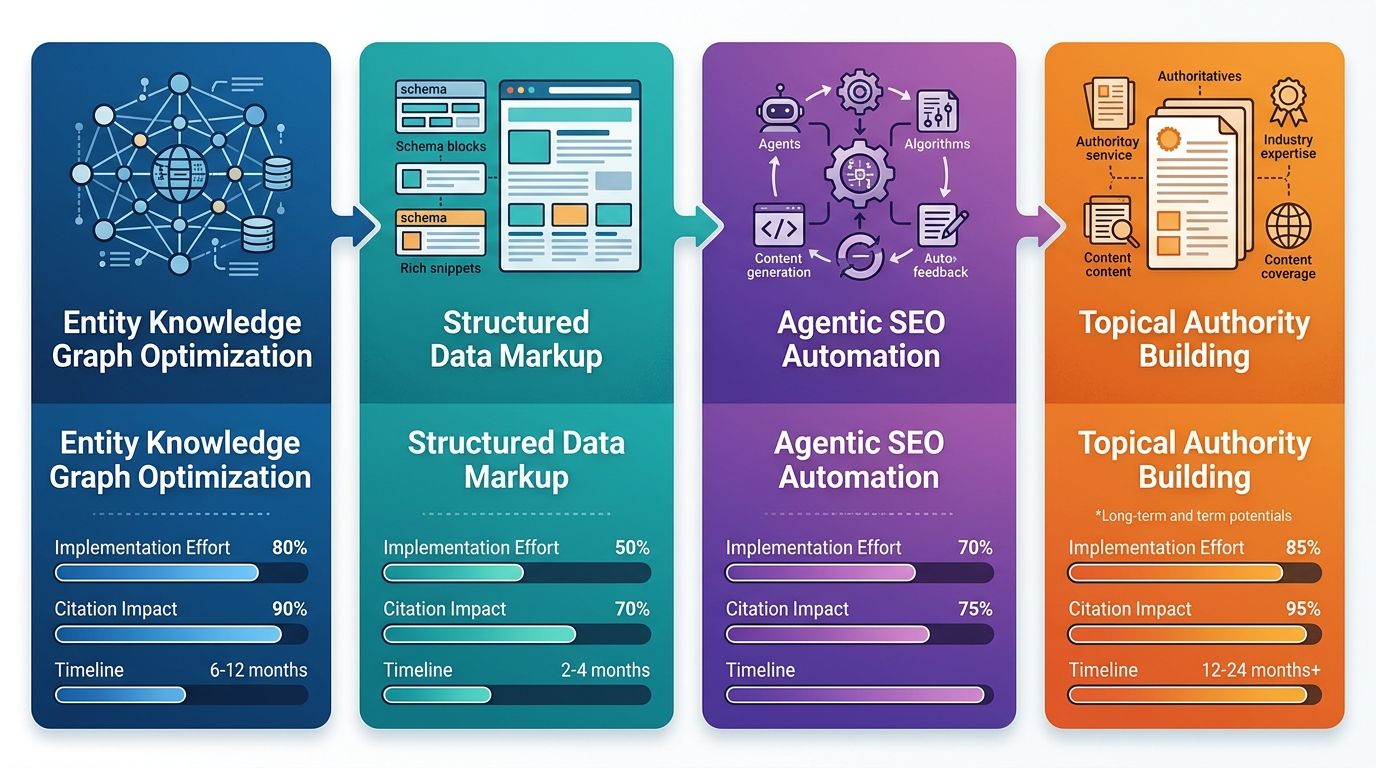
These techniques collectively improve your content's retrievability and increase your ai citation frequency. Consistently applying these methods builds a strong foundation for AI visibility. The following table compares four key strategies for boosting LLM source visibility.
| Strategy | Implementation Effort | Citation Impact | Time to Results | Best For |
|---|---|---|---|---|
| Entity Knowledge Graph Optimization | Medium | High | 2-4 months | Brands with established content libraries |
| Structured Data Markup (Schema.org) | Low | Medium | 1-2 months | All brands — foundational requirement |
| Agentic SEO Automation | Low–Medium | Very High | 1-3 months | Brands using platforms like hashtag.org |
| Topical Authority Building | High | High | 4-8 months | Agencies and content teams with editorial resources |
Our local SEO guide underscores that foundational visibility tactics such as consistent NAP data and schema markup strengthen entity knowledge graphs, directly supporting ai citation frequency efforts. Likewise, our guide on implementing web design trends for 2026 emphasizes that structured content and entity clarity help AI retrieval systems recognize your brand.
Structuring Content for Maximum Citation Potential
How you structure your content significantly influences ai citation frequency. Organizing information into topical clusters and maintaining high entity knowledge graph density makes it easier for LLMs to parse and cite your authority. We recommend:
- Build topical clusters with a central pillar page interlinked with detailed supporting articles.
- Use entity recognition tools to ensure key brands, products, and concepts are explicitly tagged.
- Format content with clear headings, bullet lists, and tables that AI can interpret as structured signals.
Structuring your content around emerging web design trends 2026 can further align your digital presence with AI retrieval expectations, as our trend implementation guide notes. Additionally, ensuring your site's technical SEO is sound — fast load times, mobile responsiveness — further boosts accessibility for AI crawlers. These content architecture strategies directly contribute to higher ai citation frequency. As LLMs increasingly rely on structured, entity-rich sources, implementing these approaches becomes a competitive differentiator.
These foundational strategies set the stage for tracking and refining your AI citation performance, which we cover next. While these methods can improve your visibility, we cannot guarantee specific outcomes; AI algorithms change continuously. For tailored implementation, consult a professional.
Advanced Techniques for Generative Engine Optimization
Building on the fundamental principles covered earlier, let’s now explore the advanced strategies that drive generative engine optimization in the emerging Agentic Web. Central to this discipline is AI Citation Frequency, which measures how often an AI model references or cites a specific source in generated answers. A higher citation rate indicates greater trust and relevance, directly impacting visibility in generative search results.
Current web design trends strongly support GEO. As Hashtag.org’s 2026 report notes, semantic HTML5, structured data markup, and mobile-first responsiveness are essential for making content machine-readable. These design choices provide clear signals for AI crawlers, enabling them to extract structured information directly from pages. By embedding schema.org vocabulary, you increase Entity Knowledge Graph Density—the depth and accuracy with which AI models understand your brand, location, offerings, and relationships. Consistent NAP (Name, Address, Phone) data across the web further reinforces entity signals, helping answer engines confidently cite your content.
To implement these strategies, we recommend:
- Deploying comprehensive schema.org markup (e.g., Organization, LocalBusiness, Product) to define entities and their interconnections.
- Building high-authority backlinks from reputable domains to signal credibility and boost citation likelihood.
- Optimizing site performance and mobile responsiveness, as AI models weigh user experience signals when selecting sources.
- Avoiding outdated tactics like keyword stuffing; instead, craft natural, context-rich content that aligns with conversational AI queries.
Furthermore, incorporating natural entities like local business identifiers and product reviews within your content enriches the knowledge graph, giving AI models richer context to cite. According to the Association of National Advertisers (ANA), adherence to industry standards for structured data transparency and content quality helps brands earn AI citations. Combining these best practices with the platform-specific strengths of geo-pinned #name portals—which natively embed entity signals—creates a powerful GEO foundation. For instance, our own portal infrastructure integrates schema.org and entity linking so that AI agents consistently discover and reference verified brand information.
As AI-driven search continues to evolve, the next logical step is to measure and monitor how these efforts translate into tangible visibility gains. Staying ahead of these trends is central to our approach at Hashtag.org, where Agentic AI powers discovery and commerce. The following section will discuss key performance indicators and monitoring tools for GEO campaigns.
Frequently Asked Questions About AI Citation Frequency
After exploring AI citation metrics in the previous section, a few common questions naturally arise. Here we address what citation frequency means, why it matters, and how you can influence it.
What is AI citation frequency?
AI citation frequency measures how often your brand appears in AI-generated outputs. It reflects your entity’s presence in the training data and retrieval frameworks that models like ChatGPT and Perplexity draw on when forming answers.
Why does AI citation frequency matter for my brand?
Frequent AI citations build authority and visibility in AI-powered search results. When a model consistently names your business, users perceive greater credibility, and discoverability rises, which can indirectly boost referral traffic and brand perception.
How does entity knowledge graph density relate to AI citation frequency?
Entity knowledge graph density describes how deeply your brand’s attributes are embedded across structured data sources. AI models rely on knowledge graphs to decide which entities are relevant, so a richer, denser graph gives stronger signals that increase the likelihood of being cited in generated answers.
How can I improve my AI citation frequency?
Applying generative engine optimization best practices—such as structuring content for entity recognition and using hashtag.org’s Agentic SEO—can raise citation likelihood. Much like conversion rate optimization aligns user intent, strategic content alignment with AI retrieval patterns helps, though no single tactic guarantees a citation.
Understanding these factors equips you to shape AI-driven visibility as the landscape continues to evolve. In the next section, we’ll explore actionable steps to start building that citational presence.
Mastering AI Citation Frequency for Greater Visibility
As AI search reshapes discovery, we focus on AI citation frequency—the count of brand mentions across authoritative sources. Just as hashtags drove social media algorithmic visibility, citation frequency drives AI model visibility.
Key points:
- It counts mentions, not links, unlike traditional SEO metrics.
- Higher AI citation frequency (50 mentions vs. 5) yields greater AI visibility.
- Structured citations (schema, knowledge graph entries) amplify raw frequency.
- Entity knowledge graph density boosts citation credibility, key for generative engine optimization best practices.
While CRO refines human conversion, citation frequency refines AI recognition. Our platform tracks this signal; the next section details improvement steps using hashtag.org’s AI Visibility Monitoring tools.